WhatsApp vs Email vs SMS: Best Channel for Conversions
Looking to boost conversions for your Shopify store? Here's the bottom line:
- WhatsApp delivers unmatched engagement with 98% open rates and 45–60% CTR, making it ideal for abandoned cart recovery, COD confirmations, and real-time support.
- SMS is perfect for urgent updates like flash sales or OTPs, thanks to its 90-second response time and 19% CTR. It's also reliable in areas with poor internet connectivity.
- Email remains the most cost-effective option for storytelling and nurturing long-term relationships, with ₹0.083 per email and automation that drives 10x higher conversions.
How do they compare?
Each channel has distinct strengths: WhatsApp excels in conversational commerce, SMS thrives on urgency, and Email is unbeatable for scalability and detailed communication. Combining all three strategically is the best way to maximise results.
Quick Comparison
| Metric | SMS | ||
|---|---|---|---|
| Open Rate | 90–98% | 15–35% | 90–95% |
| Click-Through Rate | 45–60% | 2–5% | 15–20% |
| Conversion Rate | 45–60% | 1–5% | Moderate |
| Response Time | Real-time | ~90 minutes | ~90 seconds |
| Cost per Message (₹) | ₹0.10–₹0.80 | ₹0.083 per email | ₹0.10–₹0.30 |
| Content | Rich media | Full HTML, detailed | Text-only (160 characters) |
| Internet Required | Yes | Yes | No |
Key takeaway: Use Email for brand storytelling, SMS for urgency, and WhatsApp for high-intent actions. A multi-channel approach ensures you reach customers at every stage of their journey.
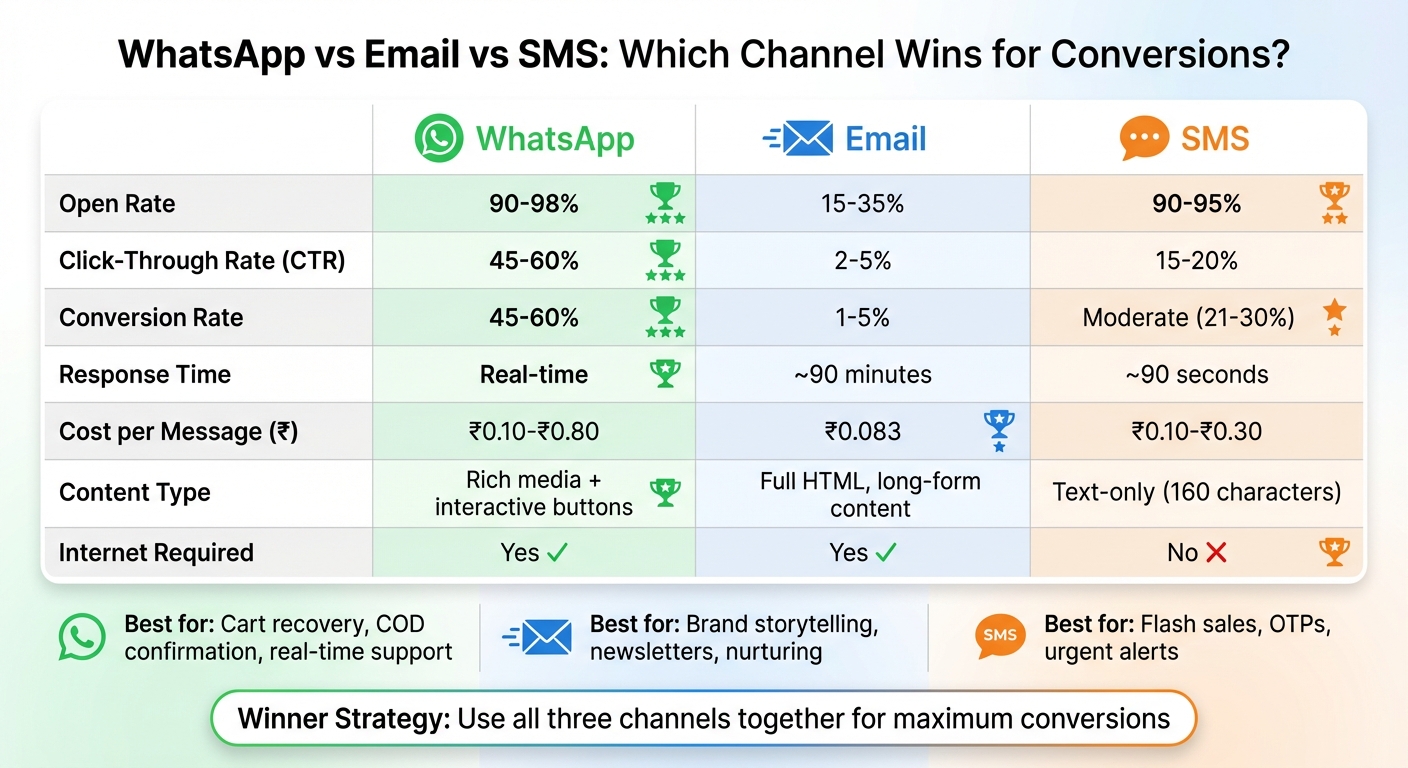
WhatsApp vs Email vs SMS: Performance Metrics Comparison for E-commerce
WhatsApp: High Engagement and Conversational Commerce
Performance Metrics and Conversion Data
WhatsApp has proven to be a powerhouse for conversions in India. With an impressive 98% open rate, and 80% of messages read within the first five minutes, it ensures that campaigns gain immediate visibility.
The platform's conversion rates are equally striking, ranging between 45% and 60%, with click-through rates between 20% and 50%, and some campaigns even hitting a peak of 80%. Automated WhatsApp reminders are particularly effective, recovering 15–25% of abandoned carts.
E-commerce businesses in India have reported staggering returns, with ROI increasing by 200–300% from WhatsApp campaigns. Additionally, these campaigns come with a 50–60% lower cost per acquisition compared to traditional search and display ads. For example, JioMart experienced a 30% boost in daily orders after integrating WhatsApp into its operations.
These statistics highlight WhatsApp's potential to transform Shopify stores by driving engagement and conversions.
Strengths of WhatsApp for Shopify Stores

WhatsApp takes broadcast messaging to the next level by enabling real-time, two-way conversations. As Arjun Paul from Zoko explains:
"Messaging replaces uncertainty with trust, something product pages alone can't provide."
This conversational approach allows customers to clarify doubts and negotiate before making a purchase, creating an experience similar to in-store shopping. It’s especially effective in Tier II and III cities, where shoppers prefer a "talk-first" approach over static product pages.
For Shopify merchants, WhatsApp addresses common challenges like customer hesitancy and cart abandonment. Its rich media features allow merchants to showcase product catalogues, carousels, and images directly in the chat. Customers can browse and add items to their cart without ever leaving the app. With features like WhatsApp Pay (powered by UPI) and one-click payment links, the checkout process becomes seamless and user-friendly.
Merchants offering Cash-on-Delivery (COD) find WhatsApp particularly useful. COD confirmation flows help reduce return-to-origin (RTO) rates by 18–35%, effectively filtering out low-intent buyers. Kishore K. from Pragma highlights the financial impact of unverified COD orders:
"One bad COD can cost you ₹160–₹240. Multiply that by your daily unverified orders… and suddenly your CAC isn't the problem - your RTO is."
Speed is another critical advantage. Responding within five minutes makes you 21 times more likely to convert a lead compared to waiting 30 minutes. Moreover, 80% of consumers prefer brands that respond within 10 minutes on messaging apps.
Case studies further illustrate WhatsApp's effectiveness. For instance, one retailer saw a 95% open rate on WhatsApp, collecting five times more customer feedback compared to email, which had a mere 1% response rate. Similarly, a grooming brand gained over 400 new WhatsApp contacts in a single day through an opt-in campaign, later converting these leads into sales through targeted offers.
Limitations and Considerations
While WhatsApp delivers strong results, it comes with its own set of challenges. The platform requires explicit opt-in from customers before initiating conversations. Building a compliant subscriber list often involves creative strategies like website pop-ups, QR codes on product packaging, or "Click-to-WhatsApp" ads on social media.
Another consideration is cost. WhatsApp campaigns are generally more expensive than email. The WhatsApp Business API costs between ₹0.12 to ₹0.80 per message in India, with some platforms charging around $0.05 (approximately ₹4.20) per message. Meta's pricing model, which charges based on 24-hour conversation sessions rather than individual messages, can also drive up costs for high-volume campaigns.
To optimise costs, businesses can adopt a push-first strategy. This involves using lower-cost communication channels initially and reserving WhatsApp for high-intent actions like cart recovery. Such a hybrid approach helps balance budget efficiency while maintaining reach and effectiveness.
sbb-itb-e5ef79e
Email: Scalable and Flexible Communication
Performance Metrics and Conversion Data
Email consistently delivers impressive results for e-commerce businesses. On average, it generates ₹3,000–₹3,500 for every ₹100 spent, with open rates ranging from 18% to 22% - sometimes even reaching 33.1% in specific benchmarks. Click-through rates hover around 2.5%–3%, and conversion rates stand at approximately 2.8%–3%.
Automation takes email performance to another level. Automated emails convert 10 times higher than bulk campaigns and account for about 37% of total email revenue. Welcome emails, for instance, boast engagement rates of 50% to 60%, while abandoned cart recovery emails convert 3% to 4% of recipients, reclaiming 10–15% of lost sales. In 2025, Shopify Email campaigns achieved an average conversion rate of 4.29%, surpassing both search (3.04%) and direct traffic.
These statistics highlight email's scalability and its ability to deliver personalised, automated experiences - qualities that are particularly beneficial for Shopify stores.
Strengths of Email for Shopify Stores
The numbers make it clear: email's scalability and automation are unmatched. As Shopify staff explain:
"Your strategy will work the same whether you're sending emails to 10 people or 100,000 people."
This scalability is powered by behaviour-driven automation. Shopify's deep data integration enables merchants to personalise emails using real-time information like product catalogues, inventory updates, and customer purchase history.
For Indian Shopify merchants, email is also highly cost-effective. Shopify Email offers 10,000 free emails per month, with additional emails costing just ₹83 per 1,000 messages (approximately ₹0.083 per email). Compared to SMS (₹1.25 per message) and WhatsApp (₹4.15 per message), email is far more affordable.
Email is perfect for long-form content and storytelling. Merchants can share product guides, brand narratives, styling tips, or educational sequences without worrying about character limits or rigid templates. Its support for HTML designs, dynamic content, and embedded media makes it more versatile than SMS and offers greater flexibility than WhatsApp templates.
Success stories further underline email's potential. In April 2025, Micki Krimmel, founder of Superfit Hero, revealed that their 40-day automated welcome series became the brand's highest-converting channel, achieving an 8% conversion rate. This sequence used tiered discounts (starting at 10% and increasing to 15% after 30 days) and included engagement efforts like Facebook group invites. Similarly, L. Eyes Eyewear reported in June 2025 that 44% of their total revenue came from email marketing, thanks to personalised flows like welcome emails, abandoned cart reminders, and post-purchase follow-ups.
Beyond immediate sales, email helps build lasting customer relationships. Research shows that 80% of potential customers who don't buy immediately will make a purchase within 24 months if nurtured effectively. Xiomara Angulo, Email Marketing Manager at ECD Digital, notes:
"Flows are what fill the space in between. They catch interest the moment it happens and move people towards the next step automatically."
For Shopify merchants, starting with the "Big Three" automations - Welcome, Abandoned Cart, and Order Confirmation - is a smart move before expanding to more advanced workflows. Dynamic segmentation, which updates automatically based on customer actions, ensures that large-scale campaigns stay relevant. Desirae Odjick, Product Marketing Lead at Shopify, advises:
"There should always be some kind of offer for signing up for your email list."
Limitations and Considerations
Despite its strengths, email does face some challenges. In 2023, about 86% of emails reached inboxes, but 7% landed in spam, and another 7% went missing. Moreover, 65% of marketers cited increasing difficulties with deliverability due to stricter spam filters and intense inbox competition. Emails often end up in promotions tabs, reducing visibility.
Response times are another drawback. While SMS responses typically occur within 90 seconds, it takes an average of 90 minutes for subscribers to respond to emails. This makes email less effective for urgent or time-sensitive messages.
Email works best when paired with other channels. A multi-channel strategy, such as starting with email and escalating to SMS or WhatsApp for low-engagement users, can optimise costs and results. For example, Frances Valentine, a clothing brand, integrated SMS into their email flows in 2021. This approach boosted revenue from abandoned checkout and back-in-stock notifications by 32% year-over-year and delivered a 21.8x ROI on SMS within eight weeks.
To improve deliverability, merchants should implement SPF, DKIM, and DMARC authentication protocols. Regularly cleaning email lists by removing inactive contacts helps maintain a strong sender reputation. Mobile optimisation is also crucial, as 55% to 60% of email opens occur on mobile devices. Using concise subject lines (under 70 characters), clear call-to-action buttons, and fast-loading designs can further enhance performance.
How to use SMS and WhatsApp for business
SMS: Urgency and High CTR for Quick Conversions
After diving into Email's scalability, let's shift focus to SMS - a channel that thrives on urgency and fast engagement. In the fast-paced world of Shopify e-commerce, SMS stands out for its ability to drive immediate responses and quick conversions.
Performance Metrics and Conversion Data
When it comes to performance, SMS delivers standout results. With a 98% open rate, an average response time of just 90 seconds, and click-through rates hovering around 19%, it’s hard to ignore its impact. For certain campaigns, like 'Back in Stock' alerts, click-through rates can soar to 36.7%–58.7%. Conversion rates are equally impressive, typically ranging from 21% to 30%, with abandoned cart messages hitting as high as 39.4%.
The financial returns are just as striking. For every ₹100 spent on SMS marketing, businesses generate ₹5,900 to ₹6,100 in revenue. In India, this channel contributes 11–20% of total e-commerce revenue for Shopify stores. For example, Domino's Pizza managed to lower its cost-per-click to just ₹12.50 using SMS, while Whisker Seeker consistently sees a 25% conversion rate on its promotional SMS campaigns.
Strengths of SMS for Shopify Stores
SMS’s biggest advantage? It doesn’t rely on internet access or app installations. This makes it a vital tool in India, particularly in Tier 2 and Tier 3 cities where data connectivity can be spotty. Plus, the immediacy is unmatched - 90% of SMS messages are opened within 3 minutes, and 81% of users check notifications within 5 minutes. This speed makes SMS perfect for flash sales, Cash on Delivery (COD) confirmations, and delivery updates.
For COD orders, SMS plays a critical role. A simple 'Reply YES to confirm your COD order' workflow helps weed out low-intent buyers, cutting Return-to-Origin (RTO) losses by up to 40%. Additionally, sending SMS reminders within 30–60 minutes of cart abandonment can recover 15–25% of lost sales. Brands like Gymshark grow their SMS lists by offering 10% discounts at checkout, while Lashify uses SMS to send a ₹1,660 discount coupon to new subscribers, followed by automated product education.
Limitations and Considerations
Despite its strengths, SMS has its limitations. The 160-character limit restricts detailed storytelling, and it doesn’t support rich media unless upgraded to MMS, which adds to costs. For COD confirmations, WhatsApp often outperforms SMS, requiring just 2 taps compared to the 7–9 steps SMS demands. WhatsApp also achieves higher action rates of 45–70%, while SMS lags behind at 10–15%.
Compliance is another key factor. In India, SMS campaigns must follow strict DLT regulations, requiring brands to register templates and sender IDs. It’s also essential to secure explicit opt-ins at checkout and include a 'Reply STOP' option for users to unsubscribe. Timing is crucial too - 45% of SMS-driven purchases happen in the evening, so avoid sending messages before 8 AM or after 9 PM.
Kishore K, Sr. Content Associate at Pragma, sums it up well:
"The same customer who ignores an SMS will happily respond on WhatsApp... but SMS remains a strong fallback channel, especially for rural pockets [and] low-bandwidth areas."
Channel Comparison: WhatsApp vs Email vs SMS
Let's break down how these channels perform based on campaign goals and customer behaviour in the Indian context.
Side-by-Side Comparison of Key Metrics
Here’s how WhatsApp, Email, and SMS stack up for Indian Shopify stores:
| Metric | SMS | ||
|---|---|---|---|
| Open Rate | 90–98% | 15–35% | 90–95% |
| Click-Through Rate (CTR) | 45–60% | 2–5% | 15–20% |
| Conversion Rate | 45–60% | 1–5% | Moderate |
| Response Time | Real-time | ~90 minutes | ~90 seconds |
| Cost per Message (₹) | ₹0.10 – ₹0.80 | Lowest (via fixed subscription) | ₹0.10 – ₹0.30 |
| Content | Rich media and interactive buttons | Full HTML, long-form | Text-only (160 characters) |
| Internet Required | Yes | Yes | No |
| Interaction Style | Two-way, conversational | Mostly one-way | One-way alerts |
WhatsApp stands out with a 45–60% CTR, outperforming Email’s 2–5%, making it a powerhouse for driving immediate actions. SMS, while boasting similar open rates to WhatsApp, lacks the ability to include rich media or interactive elements. Email, on the other hand, is cost-effective and scalable but struggles with lower open rates.
This comparison highlights each channel’s strengths and sets the stage for a deeper dive into their unique features and limitations.
Strengths and Weaknesses of Each Channel
WhatsApp
WhatsApp is ideal for high-intent actions like recovering abandoned carts or confirming COD orders. Its ability to include product images, catalogues, and interactive buttons makes it a versatile tool. However, it does require internet access and customer opt-ins .
Email
Email shines when it comes to storytelling and nurturing long-term relationships. It’s perfect for welcome series, newsletters, and detailed product education. As Sachin Dhanotiya, CEO of AiTrillion, aptly notes:
Email nurtures customers, WhatsApp activates them.
However, its lower open rates and slower response times mean brands must work harder to grab attention.
SMS
SMS is unmatched for delivering urgent updates like OTPs or flash sale alerts, especially in areas with poor connectivity. With a response time of about 90 seconds and high open rates, it’s incredibly effective for time-sensitive communication. However, its 160-character limit and lack of media options can be restrictive .
These distinctions guide how each channel can be best used for Indian Shopify stores.
Best Use Cases for Indian Shopify Stores
-
Abandoned Cart Recovery:
WhatsApp works wonders here, sending personalised messages with product images and checkout links. -
COD Confirmations:
WhatsApp simplifies COD validation, reducing the need for manual calls and cutting down return rates. -
Flash Sales and Urgent Alerts:
SMS is unbeatable for time-sensitive updates, especially for customers in low-bandwidth areas, with its high open rates and quick response times. -
Brand Storytelling and Nurturing:
Email is best for sharing detailed product information, newsletters, and loyalty programme updates in a cost-effective way . -
Real-Time Support and Post-Purchase Engagement:
WhatsApp is excellent for handling customer support and engaging with buyers after their purchase.
To maximise results, the key lies in using these channels together. As Saumya Kurian, Digital Marketing Team Lead at D7 Networks, advises:
Smart teams don't choose one - they combine all three strategically.
Use Email to build awareness, SMS for urgent updates, and WhatsApp to close the deal and maintain engagement.
Conclusion: How to Maximize Conversions
The data paints a clear picture: no single channel can guarantee conversion success across the board. WhatsApp stands out with impressive click-through rates of 35–50%, Email remains the most budget-friendly for sharing stories, and SMS is unmatched for urgent, time-sensitive updates. The key to success lies in using these channels together, strategically, rather than relying on just one.
Lizzie Davey, Content Strategist at Klaviyo, sums it up perfectly:
An omnichannel strategy doesn't mean sending more messages. It means sending the right message on the right channel at the right time.
For Indian Shopify stores, this means adopting a tailored approach: use Email to drive brand awareness and educate customers, SMS for flash sales and OTP confirmations, and WhatsApp to recover high-value carts and offer real-time support. The insights shared here underscore that each channel thrives in specific scenarios, making a well-rounded omnichannel strategy essential.
Using Messagesuite for Omnichannel Success
Executing this multi-channel approach is simpler with the right tools. Messagesuite consolidates WhatsApp, Email, and SMS into a single dashboard, enabling seamless campaign management without the hassle of switching between platforms. Its AI-powered segmentation identifies high-intent customers - like those abandoning carts worth over ₹5,000 - and triggers WhatsApp messages with rich media and interactive buttons. Meanwhile, lower-value carts are targeted with automated Emails to minimise costs.
The platform's Contact Reconciliation feature merges anonymous visitors, email subscribers, and phone contacts into unified profiles, eliminating duplicate messages and reducing unnecessary expenses. When a customer completes a purchase, automations across all channels stop immediately, ensuring a smooth and cohesive experience. Real-time analytics further help pinpoint which channel drives the most revenue, allowing you to optimise your budget effectively.
Final Recommendations for Channel Selection
- Email: Perfect for nurturing relationships through welcome sequences, newsletters, and product education.
- SMS: Best for urgency - think flash sales, OTPs, and order confirmations, especially in areas with limited connectivity.
- WhatsApp: Ideal for activation, such as recovering abandoned carts, confirming COD orders, and engaging customers post-purchase with rich media and interactive options.
FAQs
How do I choose between WhatsApp, Email, and SMS for my store?
Choosing the right platform - WhatsApp, Email, or SMS - depends on your goals, audience, and the message you want to deliver.
- WhatsApp is perfect for personal, real-time conversations and customer support. It’s great when you want to build a direct connection or provide quick assistance.
- SMS is the go-to for urgent updates or time-sensitive promotions since it boasts high open rates and instant delivery.
- Email shines when you need to share detailed information, nurture leads, or communicate at scale in a cost-effective way.
A smart strategy? Combine them. Use WhatsApp for immediate interactions, SMS for urgency, and Email for more comprehensive communication. Together, they can amplify your engagement efforts.
What’s the best channel mix for abandoned cart recovery in India?
To recover abandoned carts effectively in India, combining WhatsApp, SMS, and email works wonders. Here's why:
- WhatsApp: With open rates exceeding 80%, WhatsApp is perfect for sending personalised and timely reminders. Its conversational nature resonates well with Indian users.
- SMS: SMS is your go-to for instant alerts. It's quick, direct, and ensures the message reaches even those without internet access.
- Email: For detailed follow-ups, exclusive offers, or additional product information, email is unmatched. It allows for a more comprehensive approach.
Using these three channels together, in a way that aligns with Indian shopping habits, can help recover over 35% of lost sales.
How can I stay compliant with opt-ins for WhatsApp, Email, and SMS?
To ensure compliance, always secure explicit consent from customers before sending any marketing messages through WhatsApp, Email, or SMS. This can be done using clear opt-in forms or checkboxes that clearly outline the types of messages they can expect to receive.
It's equally important to make opting out simple and straightforward for recipients. Being transparent about how their data will be used and respecting their preferences not only helps with compliance but also fosters trust.