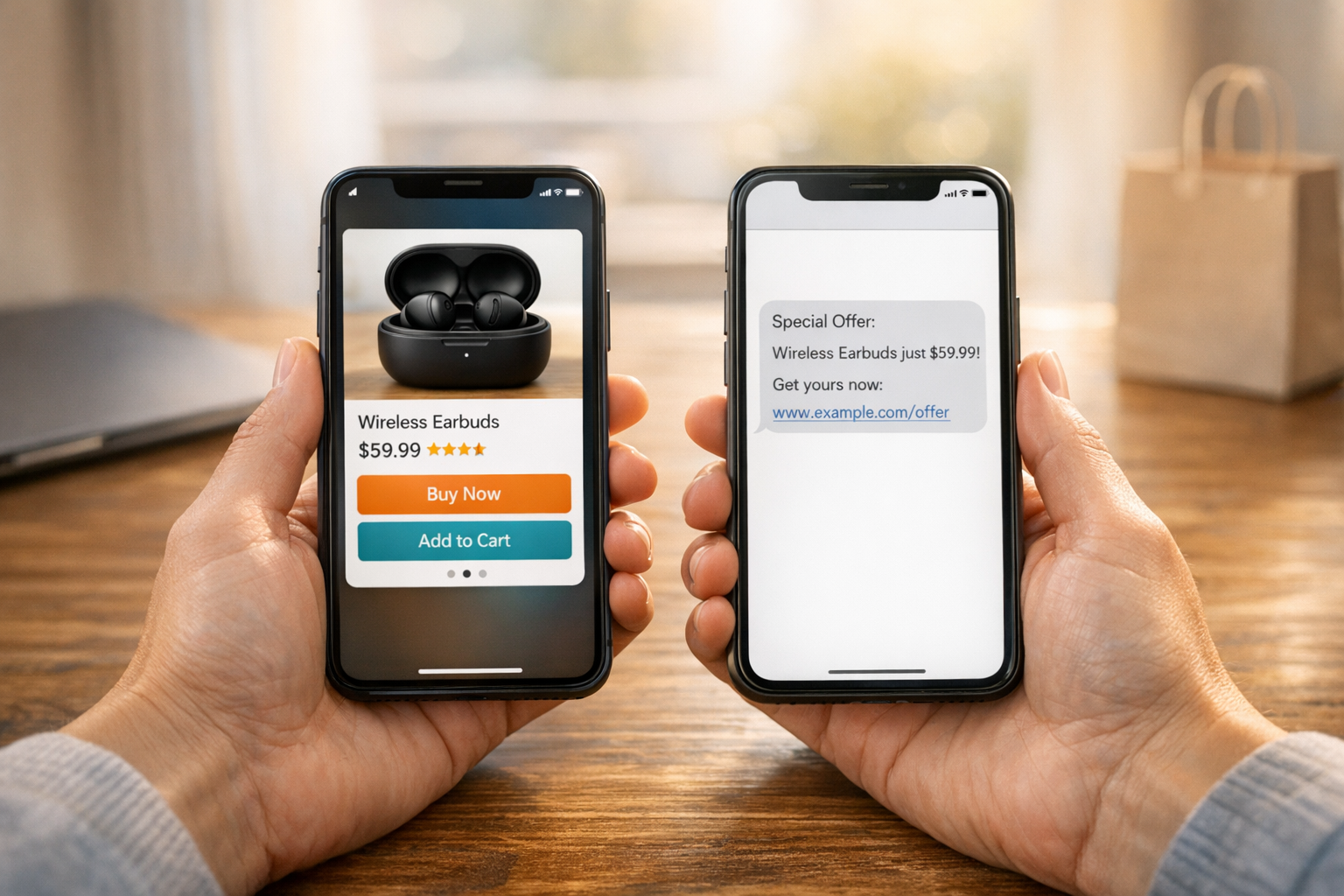
RCS vs SMS: Which Messaging Channel Drives More Sales?
RCS and SMS are two powerful messaging tools for e-commerce, but which one is better for driving sales? Here's the quick answer:
- SMS: Reliable for urgent alerts, broad reach, and quick engagement. With a 98% open rate and ROI of $71 per $1 spent, it’s ideal for time-sensitive updates like flash sales or shipping notifications.
- RCS: Offers rich, interactive features like product carousels, high-res images, and "Buy Now" buttons. Conversion rates can hit 80%, far exceeding SMS’s 21–40%. Great for abandoned carts, product launches, and immersive shopping experiences.
Key Takeaways:
- SMS works on any mobile phone and doesn’t need internet. Costs range from $0.0055–$0.07 per message.
- RCS needs internet but supports advanced features, with conversational pricing starting at $0.02–$0.05 per 24-hour session.
- Combining both channels (RCS first, SMS as fallback) ensures better engagement and universal reach.
Quick Comparison:
| Feature | SMS | RCS |
|---|---|---|
| Open Rate | 98% | 90–95% |
| Conversion Rate | 21–40% | Up to 80% |
| Media Support | Text/Small Images | High-res Images, Videos, Carousels |
| Interactivity | Links, Keywords | Tappable Buttons, Verified Profiles |
| Cost | $0.0055–$0.07/Message | $0.02–$0.05/24-hour Conversation Window |
For Shopify stores, a waterfall approach (RCS with SMS fallback) combines the best of both worlds, maximizing engagement and ensuring delivery for all customers.
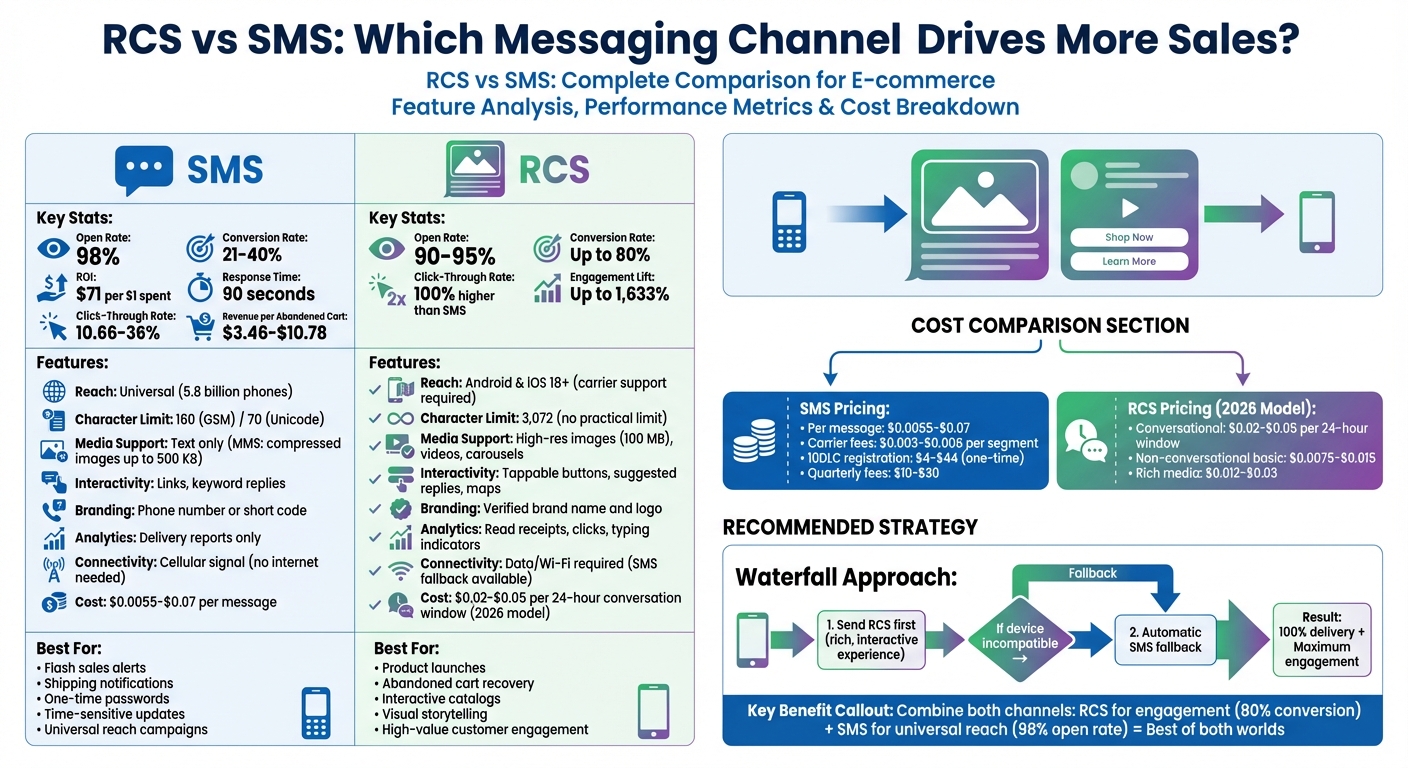
RCS vs SMS Messaging: Complete Feature and Performance Comparison for E-commerce
RCS vs SMS: Feature Comparison
Core Features and Capabilities
SMS works through cellular networks and doesn’t need an internet connection, which makes it ideal for reaching customers in areas with limited connectivity. On the other hand, RCS relies on internet access but can automatically switch to SMS when the connection isn’t available.
The difference in character limits is another standout factor. SMS messages are capped at 160 characters when using standard GSM-7 encoding. Including emojis or special characters reduces this limit to 70, which can lead to higher costs as messages are split into multiple segments. RCS, however, allows for detailed messaging without any practical character restrictions.
When it comes to multimedia, the gap widens further. MMS can only handle compressed images up to 500 KB, while RCS supports high-resolution images as large as 100 MB - roughly 200 times the size limit of MMS. RCS also supports features like video, product carousels, and interactive elements like tappable buttons (e.g., "Buy Now" or "Track Order"), turning messages into dynamic, mini storefronts.
Branding is another area where RCS shines. SMS messages often appear from generic phone numbers or short codes, which can feel impersonal. RCS, however, displays your verified brand name and logo directly in the message thread, helping establish trust and authenticity.
Analytics capabilities also differ significantly. SMS provides basic delivery reports, but RCS offers advanced metrics such as read receipts, typing indicators, and button-click tracking. These features give businesses deeper insights into customer behavior, like which products sparked interest or which calls-to-action led to conversions.
| Feature | SMS / MMS | RCS |
|---|---|---|
| Reach | Universal (any mobile phone) | Android & iOS 18+ (requires carrier support) |
| Media | Text or compressed images (MMS) | High-res video, 100 MB images, carousels |
| Interactivity | Keyword replies, plain links | Tappable buttons, suggested replies, maps |
| Branding | Phone number or short code | Verified brand name and logo |
| Analytics | Delivery reports only | Read receipts, clicks, typing indicators |
| Connectivity | Cellular signal only | Data/Wi‑Fi required (with SMS fallback) |
| Character Limit | 160 (GSM) / 70 (Unicode) | No limit |
These differences not only highlight the technical capabilities but also influence the overall cost structure, which is a critical consideration for Shopify businesses.
Cost Analysis
Pricing structures for SMS and RCS vary, and understanding them is key to choosing the right channel.
SMS is charged per message segment. Rates typically range from $0.0055 to $0.07 per segment, with additional carrier fees of about $0.003 to $0.006 per segment. In the U.S., businesses also face one-time 10DLC brand registration fees between $4 and $44, along with quarterly fees of $10 to $30.
RCS, however, is moving toward a conversational pricing model starting in 2026. Instead of paying per message, businesses will pay a flat rate of $0.02 to $0.05 for a 24-hour conversation window, during which unlimited messages can be exchanged. This approach is particularly cost-effective for customer service or sales interactions, where a single SMS conversation might otherwise rack up 8 to 12 billable messages.
For one-way notifications, like order confirmations or one-time passwords, RCS uses non-conversational pricing. Basic messages cost $0.0075 to $0.015, while rich media messages range from $0.012 to $0.03. Although these rates are higher than SMS on a per-message basis, RCS often achieves engagement rates 3 to 10 times higher, which can lower the cost-per-conversion.
Additionally, SMS costs have been rising. For instance, T-Mobile increased SMS fees by 50% in 2024 due to stricter compliance requirements. Meanwhile, RCS saw a 550% surge in global message volume in 2024, driven by Apple’s adoption of RCS in iOS 18. Ultimately, the choice between SMS and RCS isn’t just about cost per message - it’s about which channel delivers better results in driving customer purchases.
sbb-itb-e5ef79e
How RCS Drives Sales: Benefits and Examples
RCS Benefits for E-commerce Sales
RCS transforms basic text messaging into a dynamic, interactive shopping experience for Shopify stores and other e-commerce platforms. With features like high-resolution images, scrollable carousels, and one-tap buttons, businesses can keep customers engaged without ever leaving the app.
The numbers speak for themselves. RCS messages boast conversion rates of 80%, far outpacing SMS (21–30%) and email (2–5%). Open rates typically hover between 90% and 95%, while click-through rates range from 15% to 30%, a significant leap from email campaigns, which average just 1.2–5% [3, 11]. Some retailers have even seen click-through rates double when switching from SMS to RCS.
A big reason for this success? Trust. Verified sender profiles give RCS an edge, with 81% of consumers preferring it over SMS because of its added authenticity. This trust translates directly into results. For example, Saie Beauty saw a 21% drop in subscriber opt-outs after implementing RCS through Yotpo in July 2025. As John Parasco, VP of Digital at Saie Beauty, explained, "We really pretty quickly saw that our opt-outs decreased by up to twenty-one percent after implementing RCS. And to me, that just spoke volumes".
RCS also excels at recovering abandoned carts. By showcasing detailed product images, offering discount codes, and including direct "Buy Now" buttons, it removes barriers to purchase [18, 19]. With a character limit of 3,072, RCS supports rich product descriptions and persuasive storytelling, making it a powerful tool for e-commerce.
E-commerce Examples
The benefits of RCS are backed by success stories across various industries.
- Club Comex, a North American paint manufacturer, launched two RCS campaigns in April 2019. Their "Regalón Regalitro" campaign, focused on sales, brought in 115% more revenue than previous SMS efforts. Another campaign featuring interior design tips achieved a 20.6% click-through rate.
- During Black Friday in December 2024, Bodemer Auto used interactive visual carousels via RCS to showcase vehicle options. The result? A 7.7% click-through rate, a staggering 1,700% improvement over their SMS campaign running at the same time.
- Nespresso used RCS to deliver an interactive personality quiz during a holiday shopping campaign, achieving a 73% open rate, a 2.3x higher click-through rate, and a 3.7x lift in purchase intent.
- Brazilian retailer Casas Bahia promoted its "Carnê Digital" payment solution through RCS, leading to an 8% boost in orders, a 17% increase in revenue, and a 6.2x higher ROI compared to other channels.
- Even quick-service restaurants have seen success. Subway, in a test with the Sprint Network, generated 60% higher click rates for RCS promotional offers compared to standard SMS campaigns.
"RCS isn't a megaphone - it's a mic. You're not blasting out texts; you're starting conversations."
- Laura Serino, Director of Brand, Postscript
These examples highlight how RCS reduces friction and enhances convenience. Whether it's recovering abandoned carts, launching new products, or running seasonal promotions, its rich media features and interactive design consistently deliver stronger engagement and better revenue outcomes than traditional messaging.
SMS Strengths: Reliability and Reach
SMS Benefits for E-commerce
SMS continues to be a dependable choice for Shopify merchants who need reliable message delivery. Unlike RCS, SMS works without requiring an internet connection, app downloads, or advanced smartphone features, making it accessible to all 5.8 billion mobile phones worldwide.
With a 98% open rate and 90% of messages read within 3 minutes, SMS excels at grabbing attention fast. Its average response time of just 90 seconds makes it perfect for urgent communications like flash sales, shipping updates, or abandoned cart reminders.
"SMS marketing delivers 2x the ROI of email marketing. For post-purchase and cart recovery specifically, the gap is even larger." - Omnisend
Unlike email, SMS avoids spam filters and lands directly in the primary inbox - or even on the lock screen. This directness contributes to conversion rates between 21% and 40%, far surpassing email's 9–18% range. At just $0.01 to $0.05 per message, SMS is also a budget-friendly option for e-commerce campaigns.
These impressive stats highlight why SMS remains a reliable tool for driving engagement and sales.
SMS Performance Data
The numbers back up SMS's effectiveness for Shopify stores. On average, each SMS generates about $1.58 in revenue. Abandoned cart automations perform even better, bringing in between $3.52 and $10.95 per message. Click-through rates range from 19% to 36%, which is up to 15 times higher than email. Even more compelling, 73% of consumers say they’ve made a purchase after receiving a text from a brand.
To keep SMS campaigns effective, it’s essential to limit marketing texts to 2–4 messages per month. This approach helps maintain customer trust and minimizes unsubscribes. For added reliability, SMS can serve as a backup for RCS campaigns, ensuring messages still reach customers on older devices or in areas with poor data connections.
These strategies demonstrate how SMS can deliver consistent results and enhance customer communication when used thoughtfully.
Performance Metrics: RCS vs SMS
Side-by-Side Comparison
RCS messages boast open rates between 90–95%, while SMS leads slightly with a 98% open rate. However, the real game-changer lies in engagement. Some retailers have reported click-through rates doubling with RCS compared to SMS. Conversion rates tell a similar story: RCS can reach as high as 80%, far surpassing SMS's 21–40% range.
When you dig into the numbers, the differences in performance become even more apparent. For instance, SMS marketing delivers an impressive $71 in ROI for every $1 spent, with abandoned cart messages generating between $3.46 and $10.78 per message. RCS, on the other hand, leverages its interactive features to amplify revenue opportunities even further.
| Metric | SMS | RCS |
|---|---|---|
| Open Rate | 98% | 90–95% |
| Click-Through Rate | 10.66–36% | 100% higher than SMS |
| Conversion Rate | 21–40% | Up to 80% |
| Average ROI | $71 per $1 spent | Boosted by interactive features |
| Revenue per Message | $3.46–$10.78 (Abandoned Cart) | Enhanced with shoppable carousels |
| Response Time | 90 seconds | Instant |
These figures highlight how each channel plays a unique role in driving revenue, helping Shopify store owners tailor their messaging strategies to specific goals.
While SMS tracks delivery and click data, RCS takes it a step further with features like read receipts, typing indicators, and interaction tracking on multimedia elements. This level of detail gives marketers a clearer picture of user behavior and campaign performance.
"RCS isn't just about making messages prettier; it's about creating seamless, revenue-driving experiences." - Rishi Malhotra, Netcore Cloud
For Shopify stores, the decision often hinges on campaign objectives. SMS excels in universal reach and fast engagement, while RCS shines in creating immersive, interactive experiences. In some campaigns, RCS has boosted engagement by up to 1,633%. This makes it particularly valuable for product launches and visual storytelling, where its multimedia capabilities can significantly enhance conversions. The choice between SMS and RCS ultimately depends on aligning your channel strategy with your campaign's specific needs - a topic we’ll continue to explore in our strategy recommendations.
RCS with SMS Fallback: The Best Approach
Why Use Both Channels
Using a waterfall strategy - starting with RCS and falling back to SMS - ensures your messages are both engaging and universally deliverable. Here’s how it works: the system sends RCS first, offering a rich and interactive experience. If the recipient’s device doesn’t support RCS or is offline, the message automatically reverts to SMS. This approach guarantees 100% delivery while maximizing engagement wherever possible.
By combining RCS's interactive features with SMS's universal compatibility, you create a system that caters to everyone. Customers with modern devices gain access to an app-like experience, while others still receive the essential message via SMS.
This hybrid strategy is a game-changer for conversions. RCS enables dynamic features like product carousels and interactive shopping flows, which can drive sales. Meanwhile, SMS is perfect for urgent updates like one-time passcodes or shipping notifications. Plus, RCS adds an extra layer of trust with verified sender profiles, complete with brand logos and trust badges. Together, these tools not only ensure delivery but also help Shopify stores boost their conversion rates.
"The real power lies in using them together... create a communication 'journey' or 'waterfall' that prioritizes the richest experience first, with an automatic fallback to ensure delivery." - Rishi Malhotra, Netcore
Messagesuite makes adopting this integrated approach seamless, ensuring your customers always receive the right message in the best possible format.
How Messagesuite Enables This Strategy
Messagesuite simplifies this hybrid messaging strategy with its AI-powered omnichannel platform. The platform evaluates each customer’s device, carrier, and connectivity in real time to automatically choose the best format - RCS, MMS, or SMS - eliminating the need for manual adjustments.
Its AI-driven segmentation takes things a step further by analyzing customer behavior and purchase history. This allows you to prioritize RCS for high-value opportunities, like carts over $100, where the investment in richer messaging is more justified. Meanwhile, SMS can handle quick updates or lower-value transactions. A unified dashboard lets you track key metrics, such as read receipts, click-through rates, and revenue per message, across all channels.
Thanks to its seamless Shopify integration, Messagesuite syncs your product catalog, order data, and customer profiles effortlessly. For example, when sending abandoned cart messages, the platform can generate auto-apply discount links, removing the need for manual code entry - a feature that typically increases conversions by 15–20%. It also ensures compliance with TCPA regulations by scheduling messages only between 8:00 AM and 9:00 PM in each recipient’s local time zone.
RCS vs SMS – The Evolution of Mobile Messaging [Live session]
Conclusion: Selecting Your Messaging Channel
Choosing the ideal messaging channel for your e-commerce goals isn’t about picking a clear winner between RCS and SMS - it’s about aligning the strengths of each with your specific needs. SMS remains a go-to for urgent, time-sensitive updates like shipping notifications, one-time passcodes, and flash sale alerts. Its broad reach and ability to drive cart recovery rates between 24% and 39% make it a must-have for Shopify stores.
On the other hand, RCS stands out when visual appeal and interactivity are key. It’s perfect for product launches, interactive catalogs, and abandoned cart reminders where customers benefit from high-resolution images of items they’ve left behind. Features like verified sender profiles and interactive buttons (e.g., "Buy Now") not only build trust but also simplify the buying process. These capabilities give RCS an edge in boosting conversions and engagement beyond what standard SMS can deliver.
For most Shopify stores, a waterfall approach works best. Start with RCS for customers with compatible devices (Android and iOS 18+), and seamlessly switch to SMS if RCS delivery isn’t possible. This ensures 100% message reach while optimizing engagement wherever possible. Use RCS for high-value interactions, such as personalized product suggestions, while reserving SMS for essential operational alerts. This strategy ensures efficiency and keeps your messaging efforts running smoothly.
Messagesuite makes this process effortless with its AI-powered platform, which automatically chooses the best message format based on device compatibility, carrier, and connectivity. Its unified dashboard tracks performance metrics, while Shopify integration and TCPA compliance let you focus on growing your business.
To get the most out of both channels, map your messages to the customer lifecycle. Use SMS for transactional alerts and RCS for marketing campaigns. Keep marketing texts limited to 2–4 per month, and send post-purchase upsell messages within 30 minutes. By using each channel where it performs best, you’ll maximize both engagement and revenue, giving your Shopify store a competitive edge.
FAQs
How do I know which customers can receive RCS?
To determine which customers can receive RCS messages, check if their devices and carriers support RCS messaging. This depends on having both a compatible smartphone and the necessary network infrastructure. If RCS isn't supported, messages will automatically be sent as SMS instead.
What should I send via RCS vs SMS?
RCS (Rich Communication Services) is perfect for sending interactive messages packed with multimedia elements like images, videos, carousels, or actionable buttons. It’s great for showcasing products, running detailed promotions, or enabling instant actions like browsing or purchasing - all in one message.
On the other hand, SMS (Short Message Service) is the go-to option for quick, time-sensitive communication. Whether it’s order confirmations, alerts, or urgent promotions, SMS delivers concise and straightforward messages. Plus, it works universally, making it ideal when multimedia isn’t necessary.
How do I stay TCPA-compliant with marketing texts?
To comply with TCPA regulations, make sure you have clear and explicit consent from consumers before sending any marketing text messages. Always include a simple opt-out option in every message, so recipients can easily stop future communications. Stick to the allowed timing restrictions for sending messages, and double-check that your content aligns with current rules.
It’s also crucial to stay informed about both federal guidelines and carrier-specific requirements. Partnering with legal professionals can help ensure your practices remain compliant. Lastly, maintain detailed records of consumer consent - this can protect you from penalties and reduce the risk of your messages being blocked.