
7 Ways to Segment Customers Using AI for E-commerce
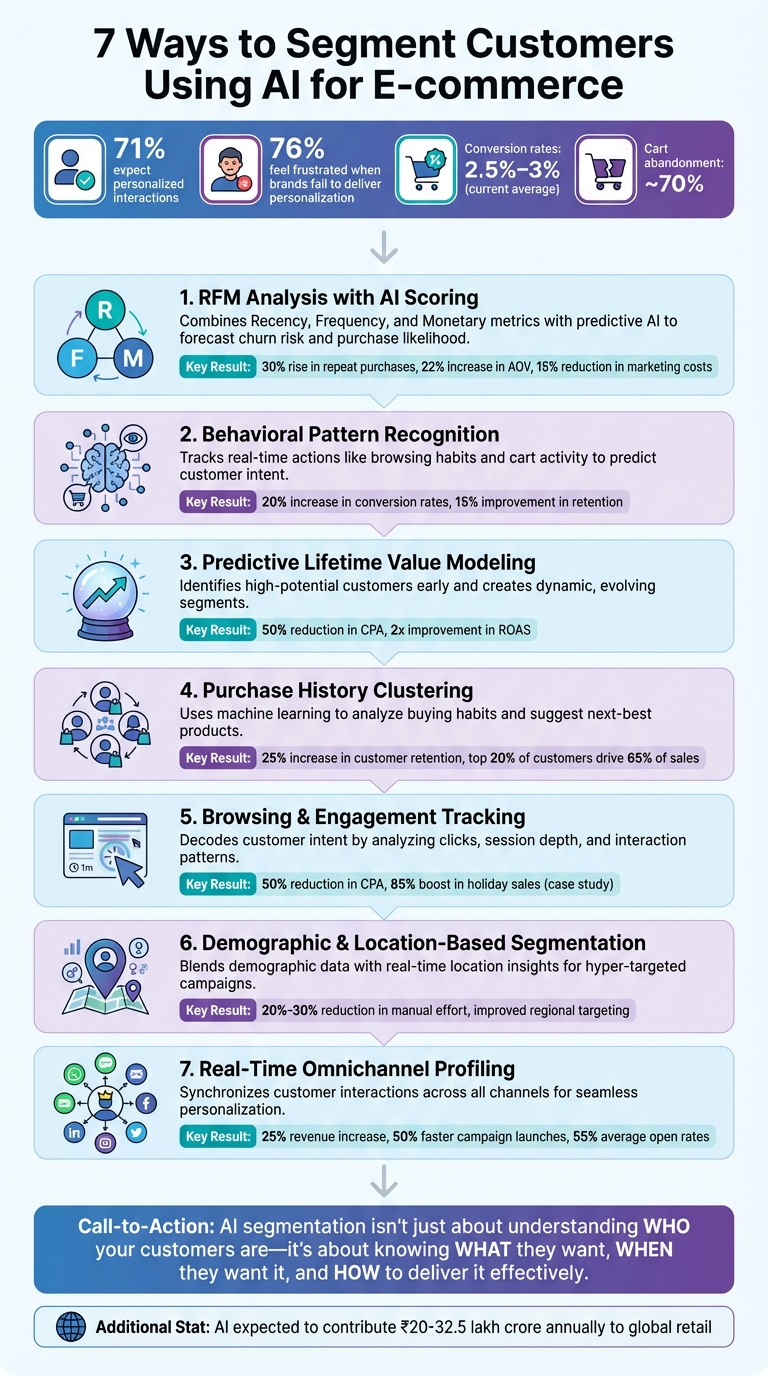
Running an e-commerce store in India? Personalisation isn't optional anymore. 71% of customers expect personalised interactions, and 76% feel frustrated when brands fail to deliver. AI-powered customer segmentation allows you to move beyond generic categories like "women aged 25–35" or "customers in Mumbai" and instead create precise, actionable segments tailored to individual behaviours, preferences, and needs.
Here are 7 AI-driven techniques to boost sales, improve retention, and reduce cart abandonment in India's diverse market:
- RFM Analysis: Combines Recency, Frequency, and Monetary metrics with predictive AI to forecast churn risk and purchase likelihood.
- Behavioural Pattern Recognition: Tracks real-time actions like browsing habits and cart activity to predict intent.
- Predictive Lifetime Value Modelling: Identifies high-potential customers early and creates dynamic, evolving segments.
- Purchase History Clustering: Uses machine learning to analyse buying habits and suggest next-best products.
- Browsing & Engagement Tracking: Decodes customer intent by analysing clicks, session depth, and interaction patterns.
- Demographic & Location-Based Segmentation: Blends demographic data with real-time location insights for hyper-targeted campaigns.
- Real-Time Omnichannel Profiling: Synchronises customer interactions across WhatsApp, SMS, email, and more for seamless personalisation.
Why it matters: AI-powered segmentation isn't just about understanding "who" your customers are. It's about knowing "what" they want, "when" they want it, and "how" to deliver it effectively. With conversion rates stuck at 2.5%–3% and cart abandonment hovering around 70%, these strategies can make a measurable difference in your revenue.
Dive into these methods to personalise every interaction, re-engage at-risk customers, and maximise your marketing ROI.
7 AI-Powered Customer Segmentation Techniques for E-commerce
Master Customer Segmentation: Boost Engagement & ROI with AI.
sbb-itb-e5ef79e
1. RFM Analysis with AI Scoring
RFM analysis combines the timeless metrics of Recency (when a customer last made a purchase), Frequency (how often they shop), and Monetary (how much they spend) with the predictive power of AI. Traditional RFM methods focus solely on historical data, but AI takes it a step further by forecasting behaviours like churn risk, purchase likelihood within the next 30–60 days, and lifetime value projections.
AI-Driven Segmentation Capabilities
AI enhances segmentation by merging transactional data with non-transactional cues like browsing history, email interactions, and cart abandonment. This allows businesses to identify patterns that signal potential churn. For instance, if a previously loyal customer reduces their email engagement, AI can flag them as "At-Risk", enabling proactive win-back strategies.
K-means clustering further refines segmentation, uncovering customer groupings that manual analysis might overlook. A case study from MetricMosaic highlights this capability: a supermarket chain saw a 30% rise in repeat purchases and a 22% increase in average order value, all while cutting marketing expenses by 15%. By using AI, businesses can determine not just what customers have bought but also the optimal timing for re-engagement.
Scalability for E-Commerce Businesses
As customer bases grow, manually tracking RFM data becomes unmanageable. AI simplifies this by processing millions of data points in real time, adjusting segments automatically as new transactions occur. This dynamic approach ensures that personalised marketing efforts remain relevant, even as businesses scale.
AI's ability to continuously update customer segments based on evolving behaviour allows for automated, personalised journeys. This "always-on" approach keeps marketing strategies aligned with customer needs, regardless of business size.
Impact on Personalisation and Revenue Growth
AI-powered RFM segmentation has been shown to increase campaign response rates by 50% (with an average of 4.2%) and improve retention by 25% over a year. It also helps avoid margin erosion by distinguishing between price-sensitive customers and high-value buyers. For example, "Champions" are more likely to pay full price, while "At-Risk" customers may need targeted incentives.
"RFM analysis isn't just about looking at past purchases. It's about predicting future behaviour." – MetricMosaic
To get started, focus on four to eight key segments, such as Champions, At-Risk, Potential Loyalists, and Hibernating customers. These segments can be seamlessly integrated into platforms like Klaviyo, Meta Ads, and Google Ads for consistent messaging across channels. When calculating the Monetary score, use net revenue (total sales minus refunds) to avoid misclassifying high-return customers as VIPs.
2. Behavioral Pattern Recognition
Behavioral pattern recognition goes beyond the traditional RFM (Recency, Frequency, Monetary) scoring by focusing on real-time customer actions. It segments customers based on behaviours like browsing habits, product interactions, cart abandonments, and purchase frequency. Using machine learning, this approach analyses vast datasets - including clicks, session durations, location data, and seasonal trends - to uncover customer intent. It also identifies micro-segments, which can predict outcomes such as repeat purchases or churn risk, allowing businesses to engage proactively. This dynamic segmentation forms the groundwork for advanced AI tools that forecast customer value and behaviour.
AI-Driven Segmentation Capabilities
AI employs probabilistic segmentation to estimate customer lifetime value (CLV) and predict how different segments will respond to marketing strategies. For instance, natural language processing (NLP) can extract insights from customer reviews, social media discussions, and support tickets to assess brand sentiment. A real-world example comes from June 2025, when Daniel Lewis, CEO of LegalOn, shared how their AI system predicted a 47% surge in demand for linen dresses by analysing viral TikTok trends and weather patterns. Acting on this insight, the company adjusted inventory, preventing dead stock worth approximately ₹16.6 crore and reducing stockout-related losses by 32%.
Scalability for E-Commerce Businesses
AI also enables businesses to scale segmentation effortlessly, processing massive amounts of data in ways manual methods cannot. Deep learning models analyse unstructured data, such as clickstreams and social media mentions, to uncover hidden behavioural patterns. For example, in December 2025, footwear retailer Rothy's used a conversational AI bot named "Sandi", powered by Gladly, to handle routine customer queries via SMS and chat. The bot resolved 31% of these interactions, contributing to a 93% customer satisfaction score. Companies that utilise behavioural segmentation have reported up to a 20% increase in conversion rates and a 15% improvement in customer retention.
Integration with Shopify Platforms

Shopify offers AI tools like Shopify Magic for content creation and Shopify Flow for automating workflows. These tools can trigger personalised actions, such as discounts or notifications, when a customer enters a high-value behavioural segment. Additionally, third-party integrations allow seamless syncing of these segments with platforms like Meta Ads, Google Ads, and Klaviyo. This enables marketers to create "seed audiences" for lookalike modelling. Features like browse abandonment flows, which target engaged shoppers with tailored recommendations, further boost conversion rates.
Impact on Personalisation and Revenue Growth
AI-powered personalisation has been shown to significantly enhance engagement rates - by as much as 30% compared to generic campaigns. In 2025, jewellery boutique Olive & Piper used the LimeSpot AI tool to provide real-time personalised recommendations. Through A/B testing, they achieved a 35% increase in conversions. Combining insights like identifying 'high spenders' with signals such as email inactivity allows brands to create highly targeted re-engagement campaigns. Behavioural pattern recognition is quickly becoming a necessity for staying competitive in e-commerce.
3. Predictive Lifetime Value Modeling
Predictive Customer Lifetime Value (CLV) modelling builds on behavioural insights to forecast the future value of customers. By leveraging propensity scoring, it predicts a customer's likelihood of making their next purchase, their risk of churn, and their interest in specific products. Machine learning plays a key role here, identifying patterns in customer actions - such as browsing habits, cart activity, email engagement, and seasonal preferences - that might go unnoticed in manual analysis. This approach enables businesses to spot "rising stars", or high-potential customers, early in their journey. It’s a forward-thinking method that supports dynamic segmentation powered by AI.
AI-Driven Segmentation Capabilities
AI-powered predictive models allow for dynamic segmentation that adapts in real time as new data becomes available. Unlike static customer groups that can quickly become outdated, these models continuously evolve. Using automated feature engineering, they can process and analyse complex datasets, eliminating the need for a dedicated data science team. For example, propensity modelling can differentiate between customers who are "barely drifting" and those who are "truly lapsed." This enables businesses to automate timely actions, such as sending replenishment reminders or launching win-back campaigns. As Reema Singhal from Retain Marketing puts it:
"Propensity modelling is a more precise way to say yes - yes to the right person, at the right moment, for the right reason".
Scalability for E-Commerce Businesses
Predictive insights make it possible to create highly scalable models for micro-segmentation, enabling personalised marketing that would be impossible for manual teams to achieve. By concentrating resources on high-propensity segments and avoiding low-likelihood audiences, businesses can bring down their Customer Acquisition Cost (CAC) and boost their Return on Ad Spend (ROAS). For instance, companies have reported cutting their Cost Per Acquisition (CPA) by 50% while doubling their ROAS using these methods.
A case in point: in 2025, Vikings Nutrition implemented bilingual segmentation (English and French) with targeted product campaigns, generating ₹20.5 lakh (approximately $24,156) in revenue within just 30 days. Similarly, Jubilee Scents used AI-guided email sequences tailored to customer intent, earning ₹5.9 lakh (about £5,549) in six days through only eight targeted emails.
Integration with Shopify Platforms
Shopify-compatible platforms take first-party data - such as order history, product interactions, and engagement metrics - and transform it into predictive audiences. These audiences can be synced directly with advertising platforms like Meta, Google, and TikTok for more effective targeting. This integration ensures consistent, personalised messaging across channels. For example, marketers can create lookalike audiences based on predicted lifetime value instead of just past spending patterns.
Automated lifecycle flows can also be customised using propensity scores. High-repurchase segments might receive product recommendations, while at-risk customers could be sent brand-focused content and helpful guides to rebuild trust before a sale attempt. Starting with simple predictive tags like "Likely to repurchase (30 days)" and "At risk (60+ days)" can immediately enhance the performance of automated workflows.
Impact on Personalisation and Revenue Growth
Predictive modelling allows brands to tailor their campaigns, driving higher Average Order Values (AOV) and improving customer retention. When combined with real-time recommendations, predictive segmentation can boost AOV by 32% and reduce churn by up to 45% through targeted retention strategies.
For instance, DoggieLawn transitioned to Shopify Plus in 2025 and implemented data-driven strategies with partner Praella, achieving a 33% increase in conversions. Similarly, Vishal CPA Prep focused on content-led campaigns designed to educate and motivate, which generated ₹20.6 lakh (approximately $24,308) in just two months.
With 71% of consumers expecting personalised experiences and 76% expressing frustration when those expectations aren’t met, predictive lifetime value modelling is now a critical tool for staying competitive in India’s e-commerce market.
4. Purchase History Clustering
Expanding on RFM analysis and behavioural pattern recognition, purchase history clustering delves deeper into understanding customer buying habits. By employing machine learning algorithms like K-means, Hierarchical clustering, and DBSCAN, this method identifies customer segments that manual analysis might overlook. It examines patterns such as product preferences, purchasing frequency, and sensitivity to discounts, focusing on how customers behave rather than just who they are .
AI-Driven Segmentation Capabilities
AI-driven clustering takes customer segmentation to the next level by refining insights from basic RFM (Recency, Frequency, Monetary) analysis. It categorises customers into actionable groups like "Champions", "Potential Loyalists", and "At-Risk" . Unlike traditional methods that rely on broad metrics, clustering digs into detailed behavioural profiles, such as:
- Products frequently purchased together (SKU affinity)
- Buying frequency or cadence
- Sensitivity to discounts
These insights help predict the "next-best-product" and estimate the "time-to-next-order." For example, businesses can send timely replenishment reminders or cross-sell offers, reducing the risk of customer churn . As Kuma Marketing aptly states:
"Segmentation is not a reporting exercise. It is an operating system for growth." - Kuma Marketing
One case study highlights an express delivery company that used AI-powered RFM clustering to identify its top 10% of customers, who accounted for 58% of total revenue. By targeting these high-value groups, the company improved customer retention by 28% in six months and kept churn at just 5%, compared to 35% for lower-value segments.
Scalability for E-Commerce Businesses
Manual data analysis can be slow and cumbersome, but AI-powered platforms offer a faster alternative. These systems connect directly to platforms like Shopify, enabling real-time updates. They can process and regroup millions of customer profiles in minutes, allowing businesses to quickly respond to trends like increased browsing activity or growing interest in specific products. For many e-commerce brands, the top 20% of customers often drive around 65% of total sales, making it critical to act swiftly on these insights.
Integration with Shopify Platforms
Shopify's "Segments" tool, found under the "Customers" tab, simplifies the use of purchase history clustering. By applying filters such as order_count, total_spent, and last_order_date, businesses can create dynamic customer segments that update in real time. These segments sync seamlessly with marketing platforms like Klaviyo, Meta Ads, and Google Ads. For example, you can use the "Champions" segment to create lookalike audiences for ad campaigns, improving customer acquisition quality. Additionally, suppress recent buyers from prospecting ads for 14–30 days to minimise wasted ad spend. This level of precision enables highly targeted campaigns that directly contribute to revenue growth.
Impact on Personalisation and Revenue Growth
With 72% of consumers preferring personalised messaging tailored to their interests, purchase history clustering has become a key tool for staying competitive. Businesses leveraging RFM analysis have seen customer retention increase by 25% over a year. The definition of "lapsed" customers can vary by industry - for instance, beauty products may require a shorter re-engagement window than outdoor gear. Marketing strategies can also be adjusted based on customer segments: "Champions" might respond well to early access offers, while "At-Risk" customers may need stronger incentives with clear deadlines. Shopify store owners can use these insights to fine-tune their omnichannel strategies and achieve measurable growth.
5. Browsing and Engagement Tracking
Understanding what customers buy is one thing, but knowing why they make those choices is where browsing and engagement tracking shines. By analysing real-time behaviours - like clicks, scrolls, session depth, and interaction patterns - AI can decode customer intent. This transforms segmentation from rigid demographics to dynamic categories such as "ready to buy", "hesitant onboarder", or "at risk of churn", all based on live activity.
AI-Driven Segmentation Capabilities
Machine learning uncovers patterns that are easy to miss with manual analysis. Take "engagement velocity", for example: when a customer views multiple product pages within 24–48 hours, it signals high intent. These shoppers can be prioritised for immediate follow-ups, while less active browsers can be nurtured with targeted campaigns. AI even uses computer vision to interpret visual search behaviour, like when customers search for products using images.
By diving into first-party data, AI creates "micro-segments" that go beyond generic assumptions. These groups are based on real behaviours, offering a precise way to target customers. Shopify merchants can seamlessly integrate these insights into automated workflows.
Integration with Shopify Platforms
Shopify offers tools like Shopify Flow to automate actions based on behavioural segments. For instance, if a customer repeatedly views a product page without making a purchase, a workflow can tag them and send a personalised discount via email or SMS. Third-party apps like Akohub (₹1,600–₹16,000 per month) and Klaviyo take it a step further by enabling advanced triggers, such as messaging customers who comment on an Instagram post. These behavioural segments can also sync with platforms like Meta Ads and Google Ads, allowing merchants to create lookalike audiences from high-intent browsers who haven’t yet converted.
Impact on Personalisation and Revenue Growth
Personalisation matters - 71% of customers expect it, and 76% feel frustrated when it’s missing. AI-powered behavioural segmentation helps address this gap, cutting cost per acquisition (CPA) by 50% and doubling return on ad spend (ROAS). A great example is Chronopost, a French delivery service. During the 2022 holiday season, they used AI-driven personalised campaigns to boost sales by 85%. Shopify merchants can follow suit by automating follow-ups for cart abandoners or offering VIP perks to frequent browsers, turning casual interest into measurable revenue growth.
6. Demographic and Location-Based Segmentation
After diving into purchase history clustering and browsing behaviour tracking, let's explore how demographic and location-based segmentation takes customer targeting to the next level. By blending demographic data with real-time location and behavioural insights, AI reshapes traditional segmentation. Instead of static categories like "women aged 25–35", AI enables dynamic groupings such as "price-sensitive urban millennials within 5 km of a store" or "high-income shoppers in tier-2 cities browsing premium products". This is particularly valuable in India, where regional factors like dietary preferences and language heavily influence buying patterns.
AI-Powered Segmentation Capabilities
Machine learning processes vast amounts of data to unearth patterns that might otherwise go unnoticed. For instance, AI can identify "category loyalists" by analysing demographic details alongside purchase triggers or forecast price sensitivity by studying browsing habits and social media activity. Even external factors, like temperature fluctuations, play a role - shifting purchases in health, beauty, and grocery categories by up to 20%. AI leverages these insights to provide region-specific product suggestions. Shopify’s customer_within_distance filter is another useful tool, allowing businesses to pinpoint online shoppers near physical stores and encourage foot traffic. These insights are perfect for integration with e-commerce platforms.
Integration with Shopify or Similar Platforms
Using these tools, Shopify merchants can create hyper-focused customer segments, such as "shoppers within 10 km of a Mumbai store who abandoned their carts." These segments can then sync with Shopify Flow to automate actions like sending personalised SMS offers or inviting nearby customers to visit the store. Beyond Shopify, these segments can also be exported to platforms like Meta, Google, and TikTok to build high-value lookalike audiences. For growing businesses, this automation reduces manual effort by 20%–30% while ensuring personalised outreach at scale.
Boosting Personalisation and Revenue
The impact of these integrations is clear: 71% of shoppers expect personalised experiences, and 76% feel frustrated when brands fail to deliver. Geographic segmentation helps businesses focus their budgets on regions with higher conversion potential, while demographic insights fine-tune messaging. For example, brands can highlight vegetarian or halal certifications in specific states or create festival-themed campaigns tailored to local audiences, driving revenue growth. With 90% of consumers willing to share data for better experiences, AI-driven demographic and location segmentation turns this data into measurable results.
7. Real-Time Omnichannel Profiling with Messagesuite
Demographic and location-based segmentation offer valuable insights, but real-time omnichannel profiling takes it a step further. This approach ensures customer profiles are continuously updated across all touchpoints. Messagesuite enables Shopify store owners to unify data from WhatsApp, RCS, SMS, email, and even in-store interactions into a single, identity-driven customer view. Unlike static segmentation, this dynamic method evolves with customer actions, whether they’re browsing, purchasing, or engaging across multiple channels. It builds on earlier segmentation strategies by ensuring interactions across platforms are always synchronised.
AI-Driven Segmentation Capabilities
Messagesuite uses AI to analyse browsing habits, purchase history, and interaction patterns, creating dynamic customer segments in real time. For example, if a customer abandons their cart at 3:00 PM and revisits the product on WhatsApp at 5:00 PM, the system can instantly send a personalised offer through their preferred channel. This goes beyond static groups, identifying customers at risk of churning or those with high potential for conversion, allowing for proactive outreach. Segments adapt in real time as customer behaviours shift. With 75% of shoppers wanting personalised experiences and 90% of marketers confirming that targeted emails outperform generic ones, this capability is no longer optional - it’s essential.
Integration with Shopify
Messagesuite integrates seamlessly with Shopify, syncing data on customers, orders, and products to create automatically updating segments. By leveraging Shopify’s infrastructure, it uses live behavioural signals - like clicks, session duration, and purchase frequency - to refine segmentation. For instance, store owners can identify "customers who viewed premium products three times this week but haven’t purchased" and send them a WhatsApp message with a limited-time discount code. The platform’s unified dashboard eliminates data silos, ensuring every channel - whether SMS, email, or others - accesses the same up-to-date customer profile. This integration ensures that every interaction feeds into a cohesive, actionable profile, strengthening omnichannel strategies.
Impact on Personalisation and Revenue Growth
The results speak for themselves. Pasignia, an e-commerce brand, saw a 25% revenue increase, launched campaigns 50% faster, and achieved average open rates of 55% by using AI-driven segmentation and automation tools. By prioritising high-quality data, businesses can let AI manage up to 80% of interactions by 2030. Additionally, focusing on privacy and security has led to an 80% boost in customer loyalty - especially important in India’s data-conscious market. With Messagesuite’s real-time profiling, Shopify merchants can meet the expectations of the 71% of consumers who demand personalised experiences, turning customer data into consistent growth. This dynamic approach is key to staying competitive and driving sustained revenue.
Conclusion
AI-powered customer segmentation is becoming a game-changer in India's dynamic e-commerce space. The seven methods discussed - ranging from RFM analysis and behavioural pattern recognition to predictive lifetime value modelling and real-time omnichannel profiling - address the everyday challenges faced by Indian Shopify store owners. Whether you're dealing with high cart abandonment rates or focusing on nurturing specific customer segments, these AI-driven techniques provide actionable and effective solutions.
Generative AI is expected to contribute between ₹20 lakh crore and ₹32.5 lakh crore annually to global retail. Additionally, 80% of consumers are willing to spend up to 50% more with brands that offer personalisation. To start, pick one or two methods that align with your immediate goals. If increasing sales is your main objective, personalised product recommendations or dynamic pricing can help boost your average order value. For improving customer retention, use RFM analysis to identify your "Champions" and "At-Risk" groups, then craft targeted campaigns to reward loyalty or re-engage customers showing signs of churn. To optimise operations, explore tools like AI-powered chatbots or predictive inventory management to cut support costs and avoid inventory issues.
What sets AI segmentation apart is its ability to evolve with your customers. Unlike traditional demographic-based segmentation, which can quickly become outdated, AI-driven insights adapt as customer behaviours change. Start by testing your chosen approach for at least four weeks, track the results, and scale up from there. Over time, you can layer additional strategies and integrate tools like Messagesuite to unify customer interactions across WhatsApp, RCS, SMS, and email into a single, actionable view.
"Think small, iterate fast, then scale."
As India's e-commerce market continues its rapid growth, AI segmentation offers the tools to expand efficiently without increasing your workload. Customers already expect personalised experiences - this roadmap will help you deliver them in a way that's both effective and profitable.
FAQs
What data do I need to start AI customer segmentation on Shopify?
To kick off AI-driven customer segmentation on Shopify, start by gathering first-party data. This includes details like order history, product interactions, engagement metrics, and geographical information. Make sure the data is well-organised and accurate to ensure reliable insights.
Next, set clear objectives. For instance, you might want to pinpoint your most loyal customers or predict future spending patterns. Once your segments are defined, put them to work across your marketing channels to personalise outreach.
Finally, keep an eye on how these segments perform. Regularly evaluate their effectiveness and tweak strategies to get the best possible outcomes.
How do I choose which AI segmentation method to try first?
Start by choosing a method that fits your current data and aligns with your business objectives. Approaches like RFM (Recency, Frequency, Monetary value) or lifecycle segmentation are excellent for getting started. Use these segments across various channels, evaluate their performance, and make adjustments as needed. Once you've fine-tuned this process, consider leveraging advanced AI predictive models to take your segmentation strategy to the next level.
How do I measure if AI segmentation is improving sales or retention?
Tracking key performance indicators (KPIs) is essential to gauge the impact of AI-driven segmentation on your business. Focus on metrics like conversion rates, average order value (AOV), customer lifetime value (CLV), and retention rates both before and after implementing AI segmentation. These figures will give you a clear picture of your progress.
To measure incremental changes, use methods like A/B testing. This approach helps you compare outcomes with and without AI segmentation, making it easier to identify its effectiveness. Beyond that, keep an eye on repeat purchase rates, customer loyalty, and revenue growth over time. These metrics will help you understand how AI segmentation influences not only sales but also long-term customer relationships.