Ultimate Guide to Customer Engagement Metrics for Shopify
Tracking customer engagement metrics is essential for growing your Shopify store. These metrics help you understand how customers interact with your store, identify problem areas, and improve retention. For example, retaining customers by just 5% can boost profits by over 25%, while acquiring new customers is up to 5 times more expensive. Here’s what you need to know:
-
3 Key Metric Categories:
- Loyalty Metrics: Focus on long-term relationships (e.g., Repeat Purchase Rate, Customer Lifetime Value, Churn Rate).
- Satisfaction Metrics: Measure customer sentiment (e.g., CSAT, NPS, Customer Effort Score).
- Behaviour Metrics: Track actions like conversion rates, email clicks, and cart additions.
-
Tracking & Analysis: Use tools like Shopify Analytics or Looker Studio to centralise data and review metrics regularly:
- Daily: Monitor response times and satisfaction scores.
- Weekly: Check conversion rates and engagement metrics.
- Monthly/Quarterly: Analyse long-term metrics like CLV and churn rate.
-
AI for Personalisation: Use AI-powered tools to scale on Shopify by segmenting customers and predicting behaviours. For example:
- VIPs: Offer early access or exclusive deals.
- At-Risk Customers: Send win-back campaigns.
- Replenishment Segments: Automate reminders for likely repeat purchases.
Shopify Customer Reports Explained: Find Your VIP Buyers, Drop-Off Points, and Retention Insights
sbb-itb-e5ef79e
3 Main Categories of Customer Engagement Metrics
3 Categories of Customer Engagement Metrics for Shopify Stores
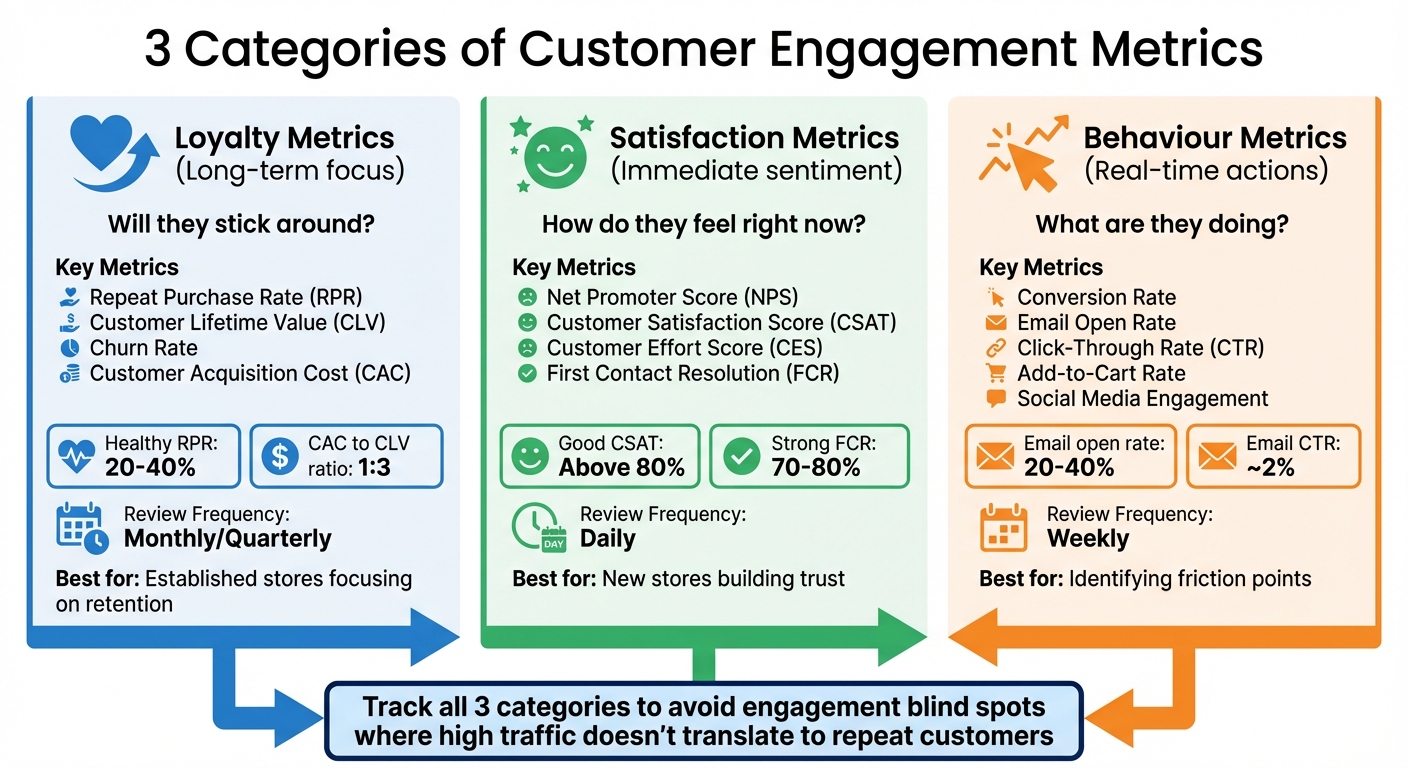
Customer engagement metrics fall into three key groups, each offering a unique lens on how customers interact with your Shopify store. Think of these as three angles: Loyalty metrics focus on long-term relationships (will they stick around?), Satisfaction metrics capture immediate customer sentiment (how do they feel right now?), and Behaviour metrics track actions (what are they doing?). Together, they provide a complete view, balancing short-term actions with long-term strategies.
Behaviour metrics act as real-time indicators, monitoring activities like email clicks or adding items to a cart. Satisfaction metrics give an instant snapshot of customer sentiment during specific interactions. Meanwhile, Loyalty metrics reveal the long-term health and revenue potential of your store. This blend ensures you're not missing out on critical insights, whether you're focusing on immediate customer needs or planning for sustained growth.
For example, a new store might prioritise satisfaction metrics like CSAT (Customer Satisfaction Score) and First Response Time to build trust, while an established store would likely focus on loyalty metrics such as CLV (Customer Lifetime Value) and churn rate to maintain momentum. Tracking all three ensures you don’t end up with an "engagement blind spot", where high traffic doesn’t necessarily translate to repeat customers.
Let’s break down how these categories can shape your strategy.
Customer Loyalty Metrics
Loyalty metrics evaluate how strong your long-term relationships with customers are. Key metrics here include Repeat Purchase Rate (RPR), Customer Lifetime Value (CLV), and Churn Rate. These metrics are forward-looking, offering a glimpse into your store’s future stability and revenue trends.
For instance, a healthy RPR for e-commerce stores usually falls between 20% and 40%. Additionally, maintaining a Customer Acquisition Cost (CAC) to CLV ratio of at least 1:3 is a common benchmark for profitability.
"The real magic for a DTC brand isn't in the first sale; it's in the second, third, and fourth." - MetricMosaic
However, consumer loyalty has been declining - only 66% of customers felt loyal to a brand in 2023, compared to 76% in 2022. Engaging customers with targeted interactions within the first 30 days after purchase can improve retention by as much as 83%.
Customer Satisfaction Metrics
Satisfaction metrics measure how customers feel about specific interactions with your store. These include Net Promoter Score (NPS), Customer Satisfaction Score (CSAT), and Customer Effort Score (CES).
A good CSAT score is generally above 80%, and a strong First Contact Resolution (FCR) rate typically falls between 70% and 80%. NPS, in particular, is a powerful tool for gauging brand advocacy - it measures how likely customers are to recommend your store to others. Given that 88% of consumers trust recommendations from friends and family over other forms of marketing, NPS can significantly influence acquisition costs.
User Behaviour Metrics
Behaviour metrics track what customers are doing in real time on your website and across marketing channels. These include conversion rates, email engagement (like open and click-through rates), and social media interactions.
These metrics are essential for identifying friction points in your sales funnel. For example, if your product pages are frequently viewed but the add-to-cart rate is low, it could signal issues like unclear product descriptions or pricing concerns.
For email campaigns, aim for an open rate between 20% and 40% and a click-through rate (CTR) of around 2%. Meanwhile, the median bounce rate for SaaS blogs is roughly 80.33%.
How to Track and Analyse Customer Engagement Metrics
Tracking customer engagement isn't just about collecting data - it’s about connecting the dots to uncover meaningful insights. Many Shopify store owners fall into the trap of looking at metrics in isolation, missing how these pieces fit together. To truly understand your customers, you need to link data from emails, sales, and support interactions. By integrating tools like Shopify Analytics, email/SMS campaign data, and customer support records, you can map out the entire customer journey in one place. The first step? Centralise all this information into a single, easy-to-access dashboard.
Setting Up a Centralised Dashboard
Shopify's built-in Analytics overview is a great starting point. It already tracks important metrics like conversion rates, average order value, and returning customer rates . But to get a more holistic view, consider using platforms like Looker Studio or Triple Whale, which allow you to pull in data from multiple sources . The idea is simple: you want to see how a customer’s email engagement, purchase history, and support interactions connect - all without juggling multiple tools.
Here’s a quick roadmap to set up your dashboard:
- Choose a platform that integrates with your existing tools.
- Identify the KPIs most relevant to your business.
- Consolidate data sources into clear, visual formats.
- Set a standard date range for consistent tracking.
- Collaborate with your team to ensure everyone’s aligned.
To dig deeper into campaign performance, use unique discount codes and trackable UTM links. These help you pinpoint which campaigns are actually driving sales.
How Often to Review Your Metrics
Once your dashboard is ready, establish a schedule for reviewing your metrics based on their nature. Not all metrics demand the same level of attention.
- Daily Monitoring: Operational metrics like First Response Time (FRT) and Customer Satisfaction (CSAT) scores should be checked daily. For instance, if your live chat response time jumps from 45 seconds to 3 minutes, you’ll want to act fast .
- Weekly Reviews: Tactical metrics, such as conversion rates, repeat purchase rates, and email click-through rates, should be reviewed weekly. This helps you identify trends as they develop.
- Monthly or Quarterly Analysis: Strategic metrics, like Customer Lifetime Value (CLV) and churn rate, require deeper analysis on a monthly or quarterly basis to evaluate your long-term business health .
Turning Metrics into Actions
Metrics are only useful if they lead to action. The key is to translate trends into tangible changes that improve your business. For example, if your First Response Time starts creeping up, consider introducing AI chatbots to handle routine queries (like "Where’s my order?"), freeing up your team for more complex issues .
If repeat purchase rates fall below 20%, it’s a sign to launch automated win-back campaigns targeting inactive customers . Similarly, a high email open rate (say, 35%) paired with a low click-through rate (under 1%) suggests a disconnect. As Mailo AI puts it, "Your subject line wrote a check that the email's content couldn't cash". Experiment with different email content, refine your calls-to-action, or adjust audience segmentation to improve engagement.
For a more seamless approach, tools like Messagesuite can be game-changers. This platform consolidates performance data from WhatsApp, RCS, SMS, and email alongside Shopify order details, making it easier to identify patterns and act quickly.
Using AI for Customer Segmentation and Personalisation
AI-powered segmentation is transforming the way businesses personalise customer interactions and predict future behaviour. By combining action-oriented metrics with AI insights, companies can elevate customer engagement and deliver tailored experiences that resonate deeply.
Here’s a striking fact: 72% of consumers engage only with messaging that aligns with their interests. Yet, many Shopify stores still rely on basic filters like “purchased in the last 30 days” or “spent over ₹5,000.” AI takes segmentation to a whole new level by analysing patterns in browsing habits, purchase triggers, price sensitivity, and even social media activity. This approach uncovers customer groups that would otherwise remain hidden through manual methods.
AI-Powered Customer Segmentation
Traditional segmentation often focuses on identifying recent buyers, but AI goes a step further by predicting who will buy next and what they’ll want. Machine learning models analyse customer data to forecast future actions, such as the likelihood of churn or the probability of a repeat purchase. This predictive approach helps prioritise high-value leads and even estimates Customer Lifetime Value (CLV) before a second purchase is made.
Take Messagesuite, for example. This platform uses AI to create real-time customer segments based on behaviours and engagement across channels like WhatsApp, RCS, SMS, and email. Instead of manually setting up segments, it identifies micro-segments automatically. These could include customers who browse late at night on mobile devices or those who abandon carts for items under ₹1,500. In March 2022, Propeller Coffee fine-tuned their segmentation by factoring in location and purchase history. According to VP Aaron Zack, this strategy boosted email conversion rates by a whopping 175%.
Automation tools like Shopify Flow further simplify the process. They trigger workflows as soon as customers enter or leave AI-defined segments. For instance, at-risk customers can be engaged immediately with targeted campaigns - no manual effort required.
Once these refined segments are in place, the next step is crafting messaging that speaks directly to each group’s needs.
Applying Segmentation for Better Personalisation
After identifying key customer segments, the focus shifts to aligning your messaging with their specific intents. For instance, a “VIP” segment thrives on exclusivity and early access, while a “Replenishment” segment benefits from timely reminders when products are likely running low. AI-powered predictive models make it possible to forecast reorder timings with precision.
Here’s a handy framework for applying AI segmentation effectively:
| Segment Type | AI Application | Marketing Action |
|---|---|---|
| VIP / Champions | High predicted spend tier | Early access to new launches, surprise gifts |
| At-Risk | Lapsing behaviour (120+ days) | Win-back campaigns featuring social proof and urgency |
| New Subscribers | Zero purchase history | Welcome emails with first-purchase incentives |
| Replenishment | Predicted product exhaustion | Automated reminders with subscription offers |
| Cross-Sell | Category affinity modelling | Suggestions for complementary products |
In 2025, Ikea introduced an AI assistant via OpenAI's GPT store that offered personalised furniture recommendations based on factors like home size, budget, and style. Francesco Marzoni, Ikea’s Chief Data and Analytics Officer, revealed that 20% of interactions with the assistant led to in-store visits within just a few months.
The takeaway? Effective personalisation relies on real data - not assumptions.
For a quick start, use Shopify’s native segments to personalise email campaigns. As your data pool grows, integrate AI-driven tools to unlock deeper insights. Track metrics like open rates, click-through rates, and conversion rates for each segment, and refine your strategy to align better with customer expectations.
Conclusion: Using Customer Engagement Metrics to Grow Your Store
Customer engagement metrics aren't just numbers - they're tools that help you build long-term value. As the Qualaroo Editorial Team explains: "Engagement is not attention; it is repeat value". The most successful stores focus on encouraging customers to return, embrace key features, and develop consistent buying habits.
Here’s why this matters: increasing customer retention by just 5% can boost profits by over 25%. Meanwhile, the average e-commerce conversion rate is 1.99%. Real growth lies in transforming that small percentage into loyal, repeat buyers. Paying close attention to these metrics can help you shift from one-off transactions to building a sustainable business. These figures are the foundation for creating actionable growth strategies.
To get started, choose a North Star metric - like repeat purchase rate - and track related drivers such as time to first value, feature adoption, and churn. Standardising definitions across teams (marketing, product, support) ensures everyone is on the same page. Then, set a review schedule: check operational metrics like First Response Time daily, tactical metrics like Conversion Rate weekly, and strategic metrics like Customer Lifetime Value (CLV) monthly.
Tools like Messagesuite make this process easier by centralising customer data for real-time insights. It pulls data from platforms like WhatsApp, RCS, SMS, and email into a single dashboard. No more switching between tools to piece together customer behaviour. With real-time revenue analytics and AI-driven segmentation, Messagesuite highlights micro-segments, such as customers who browse late at night or abandon carts under ₹1,500. This eliminates the "engagement blind spot" caused by scattered data.
Winning brands reduce customer effort, anticipate needs, and act on insights before problems lead to churn. Use your metrics to spot friction points, automate re-engagement campaigns when purchase gaps grow, and reward your most engaged customers to strengthen loyalty. By aligning your daily actions with these insights, you can turn engagement data into meaningful, long-term business growth.
FAQs
Which engagement metric should I pick as my North Star for Shopify?
Your engagement rate should be the guiding metric for Shopify. It shows how well your content or campaigns are connecting with your audience, taking into account the size of your total audience. This figure offers a straightforward way to understand customer interaction and evaluate how your campaigns are performing.
How do I link Shopify, support, and WhatsApp/SMS/email data in one dashboard?
You can leverage an AI-driven omnichannel marketing platform like Messagesuite to bring together Shopify, customer support, and WhatsApp/SMS/email data into one streamlined dashboard. This integration lets you unify customer interaction data, automate routine workflows, and monitor revenue performance with ease. By linking your Shopify store with various communication channels, you can access real-time insights, segment customers effectively, and manage campaigns from a single platform - all aimed at boosting engagement and enhancing support efficiency.
What’s the simplest way to use AI segments (VIP, at-risk, replenishment) for campaigns?
Using AI-powered tools is an easy and effective way to segment your customers based on their behaviour and value metrics, such as purchase history and engagement levels. These tools allow you to design tailored campaigns for different customer groups. For instance, you can reward your VIP customers, reach out to those who might be drifting away, or send timely restock reminders.
What makes these tools even better? Their automation features. They simplify the entire process, enabling you to personalise and scale your campaigns effortlessly - no need for tedious manual work.