
AI Product Descriptions: SEO Benefits for Shopify
AI product descriptions can save you time and boost your Shopify store's SEO performance.
Manual writing takes about 3.5 hours per product, but AI reduces this to just 30 seconds - 420 times faster. Shopify stores using AI have reported:
- 247% improvement in search rankings
- 189% increase in conversion rates
AI tools use advanced keyword integration, semantic optimisation, and dynamic updates to create descriptions that rank higher and engage readers. They also adapt to real-time trends, refresh content automatically, and handle bulk updates in minutes.
Key benefits include:
- Higher organic traffic (up to 156% growth)
- Better click-through rates (up to 89% improvement)
- Increased conversion rates (20–30% lift with A/B testing)
For best results, combine AI-generated descriptions with human editing. Tools like Shopify Magic and third-party apps and marketing features streamline the process, making it easy to implement across your store. Adding schema markup and optimising for AI-driven search engines further enhances visibility.
Start small: Generate descriptions for your top 20 products, monitor performance, and scale up. AI is no longer optional - it's the key to staying competitive in the evolving e-commerce landscape.
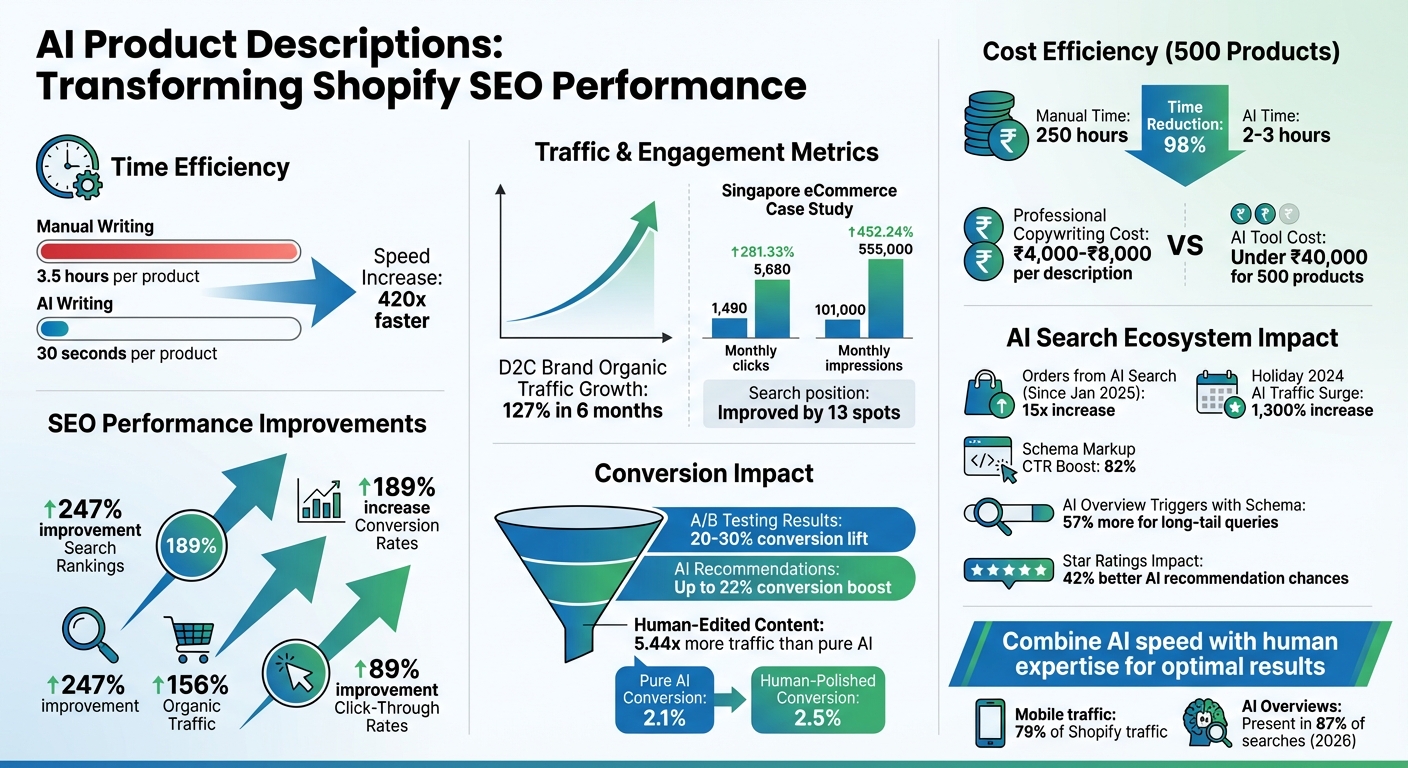
AI Product Descriptions SEO Impact: Key Performance Metrics for Shopify Stores
Secret AI Method To Write SEO Product Descriptions That Convert 🔥
sbb-itb-e5ef79e
How AI-Generated Product Descriptions Improve SEO Performance
AI has taken product descriptions to the next level, turning them into SEO powerhouses. By intelligently weaving keywords, crafting engaging language, and dynamically adapting to search trends, AI helps content rank higher on search engines while also converting casual browsers into customers.
Keyword Integration and Semantic Optimisation
AI tools, powered by advanced natural language processing (NLP) and large language models (LLMs), excel at identifying keywords that resonate with actual search intent. Instead of overusing generic terms like "running shoes", these tools pinpoint specific, less competitive phrases such as "lightweight running shoes for marathon training".
Semantic optimisation adds another layer of finesse. By analysing subtle connections between terms, AI ensures content is relevant beyond simple keyword repetition. Hiten Patel, SEO Account Director at Push, explains:
The effectiveness of your AI keyword research really depends on the language model you choose and, more importantly, the depth of information you provide. Some LLMs are great at picking up subtle semantic connections with very little input, while others need more data to deliver meaningful results.
Take Shopify Magic as an example. It scans thousands of web listings to identify features and benefits that appeal to customers. This ensures keywords naturally integrate across critical SEO elements like URLs, H1 titles, body text, and image alt tags, avoiding penalties for keyword stuffing. A study by Caseo.AI revealed that Shopify stores using AI-generated alt text experienced a 35% boost in image search rankings and a 22% rise in organic traffic.
Strategic placement is key: use the focus keyword in the URL, title, body text (once or twice), and image alt tags. The rewards are huge - the top search result garners a 45.44% click-through rate, while the second position drops to 17%.
But ranking well is only part of the equation. AI also ensures that content keeps readers engaged.
Better Readability and Customer Engagement
Search engines favour content that holds a visitor's attention. AI leverages NLP to create conversational and engaging copy that reduces bounce rates and increases time spent on a page - both important ranking factors. Instead of dry feature lists, AI focuses on benefit-driven narratives, answering questions like: "How will this product improve my life?"
Presentation also plays a crucial role. AI formats content using headlines, bullet points, and short paragraphs, making it easy to scan - especially for mobile shoppers on platforms like Shopify. This scannable structure encourages users to stay longer, signalling quality to search engines.
Deepak Shukla, Founder and CEO of Pearl Lemon, highlights:
UX determines engagement. If your site delivers a poor experience, no AI tool can salvage it.
Human oversight remains essential. Research shows that human-edited content generates 5.44 times more traffic than purely AI-generated pieces. For instance, Bankrate.com combined AI assistance with expert reviews to create over 160 articles in just six months. This effort resulted in many pages ranking on Google's first page, driving approximately 1,25,000 monthly organic visitors. Similarly, a mid-sized Shopify electronics retailer saw a 67% rise in organic traffic and an 89% improvement in click-through rates within four months by using AI-generated structured data.
Barbara Robinson, Marketing Manager at WeatherSolve Structures, stresses:
There are no chances that we will skip human oversight when it comes to customer-facing content. The initial draft is done under the assistance of AI tools, yet we make sure that the language is always revised and edited by our team.
Dynamic Updates for Trending Keywords
SEO is a moving target, with search patterns constantly evolving. AI tools stay ahead by analysing competitor strategies and real-time search data to identify trending keywords. They then refresh product descriptions automatically, ensuring content remains relevant to both customers and search engine crawlers.
AI's ability to adapt allows it to tailor messaging based on seasonal trends or market preferences. For example, it can highlight "durability" in one region while focusing on "comfort" in another - all without manual intervention. Dave Jones, Senior Marketing Manager at Nail Salon Tech, notes:
This adaptability not only enhances customer engagement but also ensures your brand remains relevant and competitive in an ever-evolving market.
AI tools also offer bulk refresh options, enabling merchants to update entire product catalogues in minutes. Brainvire AI explains:
Products change, trends shift, and SEO rules evolve. The app allows you to revisit and refresh your content whenever needed, ensuring your store stays updated and relevant in search engine algorithms.
This prevents "content decay", a common issue with large catalogues, and can lead to a 25% increase in organic traffic. While manual updates take about 3.5 hours per product, AI can complete the same task in just 30 seconds. For Shopify merchants managing hundreds or thousands of SKUs, this efficiency is essential for staying competitive as search algorithms evolve.
Next, we’ll dive into how data-driven insights quantify these SEO improvements.
Measuring SEO Success with Data-Driven Insights
Tracking the right metrics is what turns assumptions into actionable insights. While AI-generated product descriptions promise improved rankings and engagement, it's the hard data that shows whether they're truly effective. For Shopify store owners, focusing on key performance indicators (KPIs) like traffic, engagement, and conversions is essential to assess the real impact of AI-optimised content.
Organic Traffic Growth
One of the clearest indicators of SEO success is organic traffic growth - the number of visitors landing on your site via search engines without paid ads. AI-generated descriptions help by transforming generic manufacturer copy into distinct product pages, avoiding duplicate content penalties and ensuring products remain visible in search results. They also enhance discoverability with automated alt text and structured data, making products easier to find in image searches and rich snippets.
The numbers speak for themselves. D2C brands using AI SEO tools report an average 127% growth in organic traffic within six months. For example, a Singapore-based eCommerce brand used AI-driven keyword clustering and content layering from April 2024 to May 2025. The results? Monthly clicks jumped 281.33% (from 1,490 to 5,680), monthly impressions surged 452.24% (from 1,01,000 to 5,55,000), and the brand's average search position improved by nearly 13 spots.
AI-optimised content has been shown to drive a 156% increase in organic traffic and boost search rankings by 247%. As Growth Pro observed:
The leap in organic clicks wasn’t magic - it was method. We didn’t create more content. We created better-aligned content.
Such improvements in traffic naturally lead to higher click-through rates, another critical SEO metric.
Higher Click-Through Rates (CTR)
Having traffic is great, but it’s only useful if visitors actually click through to your site. Click-through rate (CTR) measures how often your search listing gets clicked compared to how often it appears. AI-generated meta descriptions and structured data make listings stand out, improving the chances of clicks.
Take the case of a mid-sized Shopify electronics store. By implementing structured data markup with AI tools, they achieved a 67% rise in organic traffic and an 89% increase in CTR within four months. More of their product pages also began appearing in Google rich snippets. Structured content specifically designed for featured snippets can boost CTR by 35%.
AI's ability to target long-tail search queries is another game-changer. For instance, phrases like "waterproof hiking boots for wide feet under ₹12,000" convert 68% better than broader terms. An outdoor gear retailer used AI to target over 200 long-tail queries in a single month, leading to a 127% traffic boost within six months.
Improved CTRs naturally lead to better engagement, setting the stage for higher conversions.
Conversion Rate Improvements
Ultimately, traffic and clicks only matter if they lead to sales. The conversion rate, or the percentage of visitors who make a purchase, is the KPI that directly impacts revenue. AI-generated descriptions improve conversions by focusing on customer needs with benefit-driven copy and easy-to-read formatting - especially important as 79% of Shopify traffic comes from mobile devices.
Stores running A/B tests on AI-generated product descriptions often see conversion rate lifts between 20% and 30%. AI-powered recommendations can further raise conversion rates by up to 22%, while personalised suggestions can enhance conversions by 15% to 20% and boost revenue by 5% to 15%.
That said, human oversight makes a difference. While pure AI-generated copy converts at 2.1%, human-polished versions achieve a 2.5% conversion rate. This aligns with findings that human-edited content generates 5.44 times more traffic than purely AI-generated material. As Milople puts it:
AI isn’t going to replace your creativity - it’s going to unleash it. By combining automation and human intuition... you can create high-converting, SEO-optimised product descriptions.
To track these results, use tools like Google Analytics 4 for conversion events such as "add_to_cart" and "begin_checkout". Monitor Google Search Console for metrics like impressions and average position, especially for comparison-focused keywords that can convert 3-4x better than generic ones. Regular A/B testing over 3-4 weeks can help pinpoint which AI-generated elements - like headlines, CTAs, or bullet points - produce the best outcomes.
Implementation Strategies for Shopify Stores

Now that the data shows how effective AI-generated descriptions can be, the next step is figuring out how to roll them out across your Shopify store. Fortunately, the process is more straightforward than you might expect, thanks to three key approaches Shopify merchants can use.
Bulk Description Generation and Automation
If your store has a large inventory, manually writing descriptions for each product is simply not practical. AI-generated descriptions save time - a lot of time. For stores with hundreds or thousands of SKUs, this efficiency can make a huge difference.
The easiest way to get started is through app-based integration. Tools like WriteText.ai, Describely.ai, and Hypotenuse AI connect directly to your Shopify admin. These apps let you import your product data, generate descriptions in bulk, and push them back to your store with just a click. Another option is CSV-based workflows. Export your product data into a CSV file, process it using AI tools like Matrixify combined with ChatGPT, and then re-import the polished descriptions.
This method can reduce the time needed for creating descriptions by 98%. For instance, writing descriptions for a 500-product catalogue manually might take around 250 hours. With AI, that drops to just 2–3 hours. And the savings don’t stop there - while professional copywriting costs ₹4,000–₹8,000 per description, AI tools can handle 500 products for under ₹40,000.
To get the best results, group products by category before running bulk generation. For example, process electronics separately from apparel. This ensures the descriptions are relevant to the product type. Also, lock down factual details like dimensions, materials, and certifications to prevent AI from altering critical specifications. Instead of publishing all descriptions at once, try staged publishing. Release them in batches, monitor metrics like bounce rates and rankings, and adjust as needed. Many tools also offer a "Needs Review" feature, flagging descriptions for human approval before they go live.
"The marginal cost per additional product approaches zero, making bulk generation dramatically more efficient for businesses with substantial product catalogues." – Product Descriptor
Once your descriptions are ready, it’s time to think about expanding into global markets.
Multi-Language Support for Global Reach
If you're selling to customers outside India, offering product descriptions in multiple languages isn’t just helpful - it’s essential. Modern AI tools can handle over 40 languages, adapting content to fit local phrasing and preferences rather than just translating it word-for-word.
To streamline this, use a Translation Management System (TMS). These systems connect to Shopify via API and automate the flow of content between your store and the translation engine. They use features like Translation Memory, which saves approved translations for reuse, and glossaries to ensure regional variations (like "colour" vs. "color") are handled consistently.
Localisation goes beyond language - it involves adjusting content to fit cultural norms, units of measurement, and even regional idioms. Additionally, your multilingual SEO strategy should cater to local search behaviour. Instead of directly translating English keywords, use language-specific terms for titles, meta descriptions, and image alt text.
Focus on the most promising markets first. Even in countries where English is widely spoken, many customers prefer shopping in their native language. Use UTF-8 encoding for CSV imports to preserve special characters and accents. Also, make sure translated meta descriptions and titles fit within platform-specific character limits to avoid truncation in search results.
"Pairaphrase has enabled us to collaborate with our distribution partners and international sales people to provide correct, quality translations whilst protecting two of our most valuable resources; time and money." – Louis Amos, European Marketing Manager, The Aquatrols Company
After setting up multi-language support, the next step is to integrate the content directly into your Shopify store.
Integration with Shopify Fields
To make the most of your AI-generated content, integrate it seamlessly into Shopify’s fields. Shopify’s own AI tool, Shopify Magic, allows merchants to generate descriptions directly within the admin interface by simply entering keywords and product features. The best part? It’s included at no extra cost for all Shopify users.
For bulk uploads, ensure your CSV columns are mapped correctly to Shopify fields like product_name, category, brand, key_features, and specifications. This keeps your data organised and avoids mismatched information. AI should also populate other key fields, including SEO title tags, meta descriptions, and image alt text, to maintain consistency across your product pages.
A smart approach is to sync AI-generated content to Shopify as "Draft" first. This gives you a chance to review and tweak the descriptions for accuracy and brand tone before they go live. Shopify’s rich text editor can enhance the layout - use headings, bullet points, and tables to improve readability and SEO.
When it comes to keyword placement, be strategic. Include your focus keyword in the URL, product title, body copy (once or twice), and image alt tags. For technical products, consider using tables or bullet points for specifications instead of long paragraphs. This not only improves clarity but also builds customer trust. And since over 70% of e-commerce traffic comes from mobile devices, keep paragraphs short - just 2–3 sentences - to make them easier to read on smaller screens.
Competitive Advantages in AI-Powered Search Ecosystems
The way people search for products is changing fast. Tools like Google AI Overviews, ChatGPT Search, and Perplexity now provide direct answers instead of just listing links. For Shopify stores, this shift opens up huge opportunities - but only if your product descriptions are ready to work with these advanced systems.
AI-driven searches are already making a big impact. Orders from AI search queries on Shopify have increased 15 times since January 2025. During the 2024 holiday season, U.S. retail websites experienced a 1,300% surge in traffic from generative AI searches compared to the previous year. This isn't just a trend for the future - it's happening now. The proven benefits of AI-generated descriptions for SEO are evolving, allowing Shopify stores to gain even more traction. Let’s dive into how optimised descriptions can boost visibility, discoverability, and credibility in this new search landscape.
Better Visibility in AI Answer Engines
AI answer engines don’t just rank websites - they combine information into a single, reliable response. To stand out, your product descriptions need to be detailed and context-rich. AI systems prioritise content that answers specific customer questions rather than just listing features.
For instance, instead of a generic description like "Waterproof hiking boots", a more effective version would be: "Waterproof hiking boots designed for monsoon treks in the Western Ghats, featuring anti-slip soles for added safety." This level of detail helps AI engines match your product to precise user queries like "best hiking boots for rainy conditions."
The ideal length for descriptions is 200–300 words of helpful context. Thin descriptions that only list technical specs are often ignored. AI Overviews are most commonly triggered during the Research (40%) and Comparison (55%) stages of the buyer's journey. This means your descriptions should address questions like, "What is this best for?" or "How does it compare to similar products?"
Interestingly, visitors referred from AI-powered search engines behave differently. They spend 8% more time on your site and view 12% more pages compared to traditional search traffic. This suggests that AI-driven recommendations bring in higher-quality traffic.
Schema Markup for Better Discoverability
Schema markup acts like a digital ID card, helping search engines and AI assistants understand your product details - like price, availability, and features. While detailed descriptions are crucial, adding schema markup can significantly improve how easily your content is discovered.
Rich results that include star ratings and pricing can increase click-through rates by 82%. Large Language Models (LLMs) are 30% better at extracting data from pages with proper schema markup, yet only 31.3% of websites use it, giving early adopters a clear edge.
Among schemas, AggregateRating makes the biggest impact. Star ratings can boost your chances of appearing in AI-generated recommendations by 42%. Stores that use comprehensive schema markup see 57% more AI Overview triggers for long-tail queries compared to those without it.
"Schema markup has evolved from a nice-to-have SEO enhancement to a critical visibility factor in AI-driven search." – Mahmudul Hasan, SEO Strategist
To maximise results, combine Product schema (price, stock, ratings) with FAQ schema (answers to common customer questions like "Is this beginner-friendly?" or "Does it work in humid conditions?"). Use the JSON-LD format, which is Google’s recommended standard and easiest for AI crawlers to process. Regularly validate your schema using Google's Rich Results Test to ensure updates or changes haven’t broken your structured data.
Citations and Authority Building
When AI engines cite your store in their answers, it elevates your brand from just another search result to a trusted expert. Citations build authority, and AI systems favour content that demonstrates E-E-A-T (Experience, Expertise, Authoritativeness, Trustworthiness).
AI-generated descriptions paired with authentic customer reviews and original product images can signal authority to AI crawlers. Including specific use cases, target audiences, and expected outcomes in your descriptions further strengthens your position.
Comparison-based searches trigger AI Overviews 55% of the time. If your descriptions include structured comparison data - like tables formatted with <thead> and <tbody> - AI systems can easily extract and cite this information.
"Instead of guessing, the AI pulls your complete, polished answer and serves it up directly in the AI Overview, clearly attributed to your store. You aren't just a search result anymore; you're the expert providing the solution." – StoreSEO
To optimise further, front-load key attributes in your product titles. Keep them under 60 characters and include details like size, material, and purpose (e.g., "Stainless Steel Water Bottle 1L for Gym Use"). This makes it easier for AI crawlers to categorise your product and match it to user queries.
Also, check your robots.txt file to ensure it doesn’t block AI-specific crawlers like OAI-SearchBot. If these bots can’t access your site, your content won’t be eligible for citations.
With AI Overviews now appearing in around 87% of searches as of 2026, optimising for AI-driven search ecosystems isn’t optional - it’s essential for staying ahead and capturing more customers.
Conclusion
AI-generated product descriptions have become a game-changer for Shopify success, especially when it comes to SEO. Stores using AI for product SEO have reported a 156% rise in organic traffic and 189% higher conversion rates - numbers that are hard to ignore. With search engines evolving to include AI-driven answer engines, optimising your content for both traditional and emerging platforms is essential.
The sweet spot lies in blending AI's speed with human expertise. While AI can churn out descriptions in about 30 seconds per product - compared to the 3.5 hours manual writing takes - human involvement still makes a big difference. In fact, content refined by humans generates 5.44 times more traffic than purely AI-written content. This "AI-drafted, human-refined" approach not only saves time but also ensures higher-quality results, reinforcing the idea that combining AI and human creativity leads to superior SEO performance.
For Shopify merchants aiming to scale this strategy, tools like Messagesuite go beyond just product descriptions. By integrating AI-powered segmentation with omnichannel campaigns (across platforms like WhatsApp, RCS, SMS, and email), you can deliver SEO-optimised product messaging to customers wherever they are. This approach boosts both visibility and conversions, making it easier to connect with your audience in meaningful ways.
To get started, focus on a few key steps: generate AI descriptions for your top 20 products, add schema markup for ratings and pricing, and A/B test headlines over 3–4 weeks. Monitor metrics like organic traffic, click-through rates (CTR), and conversion rates to refine your strategy. As Deepak Shukla, Founder and CEO of Pearl Lemon, wisely points out:
UX is where humans will shine. If your site delivers a poor experience, no amount of GPT can save it. AI will write the story, but UX decides if people stay to read it.
FAQs
Will AI-written product descriptions hurt my Shopify SEO?
When used well, AI-generated product descriptions can enhance SEO for Shopify stores by creating content that's both engaging and optimised for search engines. But without proper testing and regular tweaks, this content might not perform as effectively as human-written descriptions, which could lead to reduced traffic and revenue.
How do I stop AI from inventing product specs?
To keep AI from producing incorrect product specifications, make sure your AI tool includes content audit and rule-setting features. These help verify claims and catch potential errors. Providing accurate, structured product data is also key to reducing mistakes. Pair AI-generated descriptions with manual reviews to cross-check details and ensure everything is correct. By combining these steps, you can maintain precision and avoid fabricated product specifications.
Which KPIs should I track to prove SEO gains?
To understand the results of your SEO efforts, keep an eye on critical metrics like search engine rankings, organic traffic, conversion rates, and sales. These metrics help you gauge how effectively your strategies are improving visibility and contributing to revenue growth.