What is AI-Powered Customer Segmentation? Q&A Explained
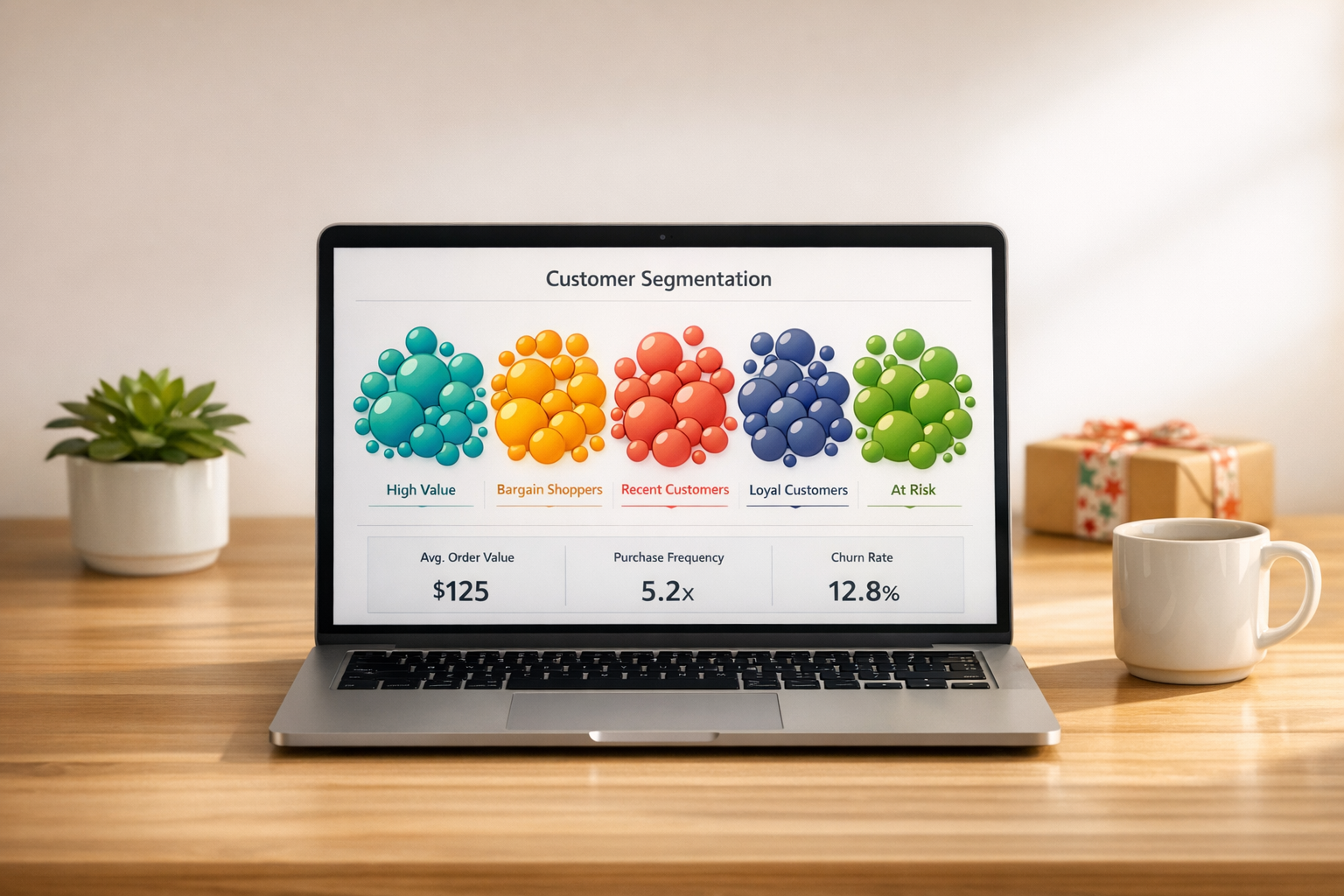
AI-powered customer segmentation uses machine learning to group customers automatically based on their behaviour, purchase patterns, and predicted future value. Unlike manual methods that rely on static filters like age or location, AI processes vast real-time data, such as browsing habits, cart activity, and purchase frequency, to create dynamic customer groups. For Shopify store owners, this means smarter targeting, personalised marketing, and improved ROI.
Key Benefits:
- Dynamic Updates: Customer groups adjust instantly based on actions like purchases or cart abandonment.
- Better Personalisation: Tailored messages for each customer segment across email, SMS, WhatsApp, and social media.
- Higher ROI: AI-driven campaigns reduce costs and boost returns, with some seeing over 100% increases in ROAS.
How It Works:
- Data Collection: AI analyses order history, browsing patterns, engagement data, and geographic details.
- Machine Learning Models: Techniques like RFM scoring, clustering, and predictive analytics identify segments like "Champions" or "At-Risk."
- Real-Time Syncing: Segments are updated and synced across marketing platforms for consistent messaging.
Indian Context:
- Festival-centric targeting (e.g., Diwali shoppers).
- Location-based campaigns for metro and non-metro audiences.
- Inventory predictions to handle demand spikes during sales.
AI segmentation tools like Messagesuite simplify this process, letting you create segments through natural language queries and automate campaigns seamlessly. Whether you're running a Shopify store in Mumbai or Bengaluru, AI helps you reach the right audience with the right message at the right time.
How to Use AI for AI-Based Customer Segmentation in Shopify

sbb-itb-e5ef79e
How Does AI-Powered Customer Segmentation Work?
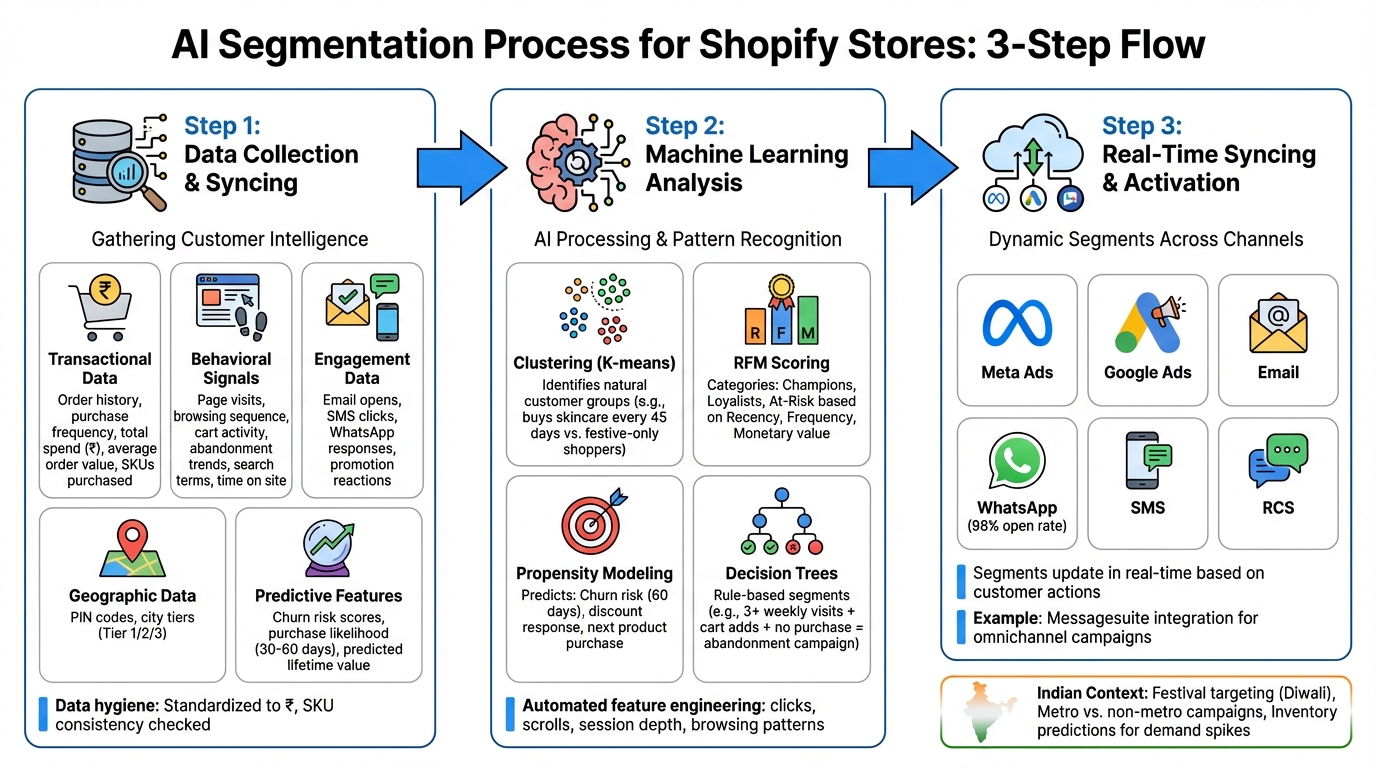
How AI-Powered Customer Segmentation Works: 3-Step Process
AI takes the idea of dynamic segmentation to the next level, turning raw data into precise, actionable customer groups. Here's a closer look at how this works, especially for Shopify stores.
Data Inputs Used for Shopify Stores
AI segmentation starts with your Shopify store's first-party data, which includes customer-approved transactional details and browsing patterns. For example, transactional data tracks order history, purchase frequency, total spending in ₹, average order value, and specific products or SKUs purchased. Whether a customer in Delhi has spent ₹20,000 across ten orders or ₹1,000 on a single purchase, AI captures these details.
Next comes behavioural signals - what pages customers visit, the order they browse in, items added to their cart, cart abandonment trends, search terms, and time spent on the site. Engagement data adds another layer, monitoring interactions with marketing efforts like email opens, SMS clicks, WhatsApp responses, and reactions to promotions. Geographic data, such as PIN codes and city tiers (Tier 1, 2, or 3), further refines targeting. Finally, predictive features generated by AI - like churn risk scores, purchase likelihood in the next 30–60 days, and predicted lifetime value - offer insights that go beyond manual segmentation.
| Data Category | Examples of Inputs | Indian Context Examples |
|---|---|---|
| Transactional | Order count, Total spend, Returns | Total spend in ₹, COD vs. Prepaid |
| Geographic | Country, State, City | PIN codes, Tier 1/2/3 cities |
| Behavioural | Cart activity, Browsing sequence | WhatsApp engagement, App usage |
| Predictive | Churn risk, Purchase probability | Predicted festival spend (e.g., Diwali) |
Machine Learning Techniques Explained
AI uses advanced techniques to analyze this data without needing manual rules. Clustering algorithms, like K-means, identify natural groupings in your customer base. For instance, it might reveal that one group buys skincare products every 45 days, while another shops only during festive sales. RFM scoring (Recency, Frequency, Monetary value) takes this a step further, categorising customers as "Champions", "Loyalists", or "At-Risk" based on their purchasing habits.
Propensity modelling predicts future behaviours, such as which customers might churn in the next 60 days, who will respond to a discount, or what product a customer might buy next. Meanwhile, decision trees break down customer behaviours into clear, rule-based segments. For example, they might flag customers who browse more than three times a week, add items to their cart, but don't complete a purchase as candidates for cart abandonment campaigns.
These models don't just define customer behaviours - they also make it easier to act on them.
The AI Segmentation Process
The process kicks off with data syncing, where the system pulls in order histories, product catalogues, customer profiles, and return data from your Shopify store. Data hygiene ensures the information is standardised - for instance, converting all currencies to ₹ and checking SKU consistency. Then, automated feature engineering processes behavioural data like clicks, scrolls, session depth, and browsing patterns. Machine learning models use this data to create dynamic segments that highlight intent signals tied to conversion or churn.
These segments are continuously updated in real time, ensuring that marketing messages are always relevant. Once defined, the segments are synced to various marketing platforms like Meta Ads, Google Ads, email tools, WhatsApp, and SMS. Tools such as Messagesuite streamline this process, integrating AI-generated segments with omnichannel campaigns. This ensures that every message - whether on WhatsApp, RCS, SMS, or email - reaches the right audience at the perfect moment.
Benefits of AI Segmentation for Shopify Stores
AI segmentation is transforming Shopify marketing by making campaigns more efficient and boosting revenue. It ensures that the right offer reaches the right person at just the right time.
Better Targeting and Higher ROI
AI takes segmentation to the next level by analysing complex behavioural patterns, going beyond simple demographics. This allows brands to focus their marketing budgets on high-value customers while avoiding low-potential audiences.
The results speak for themselves. Brands using AI segmentation have seen up to a 50% drop in Cost Per Acquisition (CPA) and more than a 100% increase in Return on Ad Spend (ROAS). Some targeted win-back campaigns, powered by AI, have even achieved a staggering 1,100% boost in performance.
Personalisation at Scale
AI makes it possible to deliver personalised messages to millions of customers at once - without any manual effort.
Given how much customers value personalised experiences, the impact can be game-changing. For example, in October 2025, a fashion retailer used real-time AI segmentation to recommend products tailored to individual customers. This led to a 32% jump in Average Order Value (AOV) in just three months. Similarly, Olive & Piper, a jewellery boutique, implemented AI tools in 2025 for personalised recommendations, resulting in a 35% increase in conversions. Even something as simple as AI-driven birthday emails has proven effective, generating nearly 7x more revenue than standard email campaigns. This ability to scale personalisation is crucial for running seamless omnichannel campaigns.
Advantages for Indian Shopify Stores
The Indian e-commerce landscape comes with its own set of challenges - handling massive sales spikes during festivals and catering to diverse metro and non-metro audiences. AI segmentation is well-suited to tackle these hurdles.
For instance, location-based filters like customer_within_distance help identify online shoppers near physical stores. This enables hyper-targeted campaigns for store-exclusive events or "buy online, pick up in-store" offers. It bridges the gap between online shopping and in-store visits, whether you're targeting Tier 1 cities like Mumbai or Tier 3 towns. You can also customise promotions based on regional preferences, such as showcasing premium products to metro customers and value deals to non-metro shoppers.
AI also excels at managing inventory during high-demand times. Predictive analytics can forecast demand spikes during key events like Diwali or Republic Day sales, reducing the risk of stockouts. This is especially crucial in India, where consumer behaviour can shift dramatically during festivals. Plus, all analytics are presented in ₹, making it easier for businesses to monitor campaign performance and ROI in their local currency.
Tools like Messagesuite seamlessly integrate these AI-driven segments into omnichannel marketing features across WhatsApp, RCS, SMS, and email. This ensures that customers enjoy consistent and personalised experiences, no matter how they interact with your brand.
Examples of AI-Generated Customer Segments
AI uses tools like RFM metrics, behavioural data, and predictive analytics to automatically segment Shopify customers. This process uncovers patterns in spending habits, purchase timing, and product preferences.
Common AI-Driven Segments
Through RFM analysis, AI identifies key groups like Champions, who are high-spending, frequent buyers contributing significantly to revenue. For instance, 44% of total revenue often comes from just 21% of customers. On the other hand, At-Risk customers show declining engagement, highlighting opportunities for re-engagement campaigns.
Behavioural segmentation dives deeper, identifying groups such as:
- Category Loyalists: Shoppers dedicated to specific product categories.
- Discount Seekers: Customers driven by deals and offers.
- Premium Buyers: Those who prioritise high-end products.
- First-Time Buyers: New customers with potential for loyalty.
- Abandoned Cart Groups: Shoppers who leave without completing purchases, a group that accounts for nearly 70% of online shopping carts.
AI also predicts churn risk, purchase timing, and Customer Lifetime Value (CLV), helping businesses spot potential high-value customers early, even before their full value is realised.
These detailed segments form the foundation for highly targeted marketing strategies across various channels.
Matching Segments to Marketing Channels
Different marketing channels align with specific customer segments. For example:
- WhatsApp, with its impressive 98% open rate, is ideal for urgent messages like abandoned cart reminders.
- Email works well for detailed storytelling and nurturing relationships.
- SMS is effective for time-sensitive promotions like flash sales, appealing to discount seekers.
- Social media ads can re-engage customers who are less responsive to direct communication.
Platforms like Messagesuite help map these segments across channels, ensuring each customer receives communication on their preferred platform.
Segment Examples for Indian Markets
AI segmentation is particularly valuable in addressing the unique challenges of the Indian retail market. Here’s how:
-
Location-Based Segments: By using filters like
customer_within_distance, businesses can target online shoppers near physical stores. For instance, customers in cities like Mumbai or Delhi - or even in smaller Tier 3 towns - can receive hyper-targeted campaigns for in-store events or "buy online, pick up in-store" offers. - Festival Shoppers: Seasonal buyers who shop during key events like Diwali, Republic Day sales, or regional celebrations can be identified. AI triggers win-back campaigns during slower periods to keep these customers engaged.
- Replenishment Segments: Perfect for consumables, AI predicts when customers are likely to run out of products and sends timely reminders to restock.
AI also supports regional targeting, enabling businesses to create tailored promotions. For instance, premium products can be marketed to metro shoppers, while value deals appeal to those in non-metro areas. All of this is tracked in ₹, ensuring campaigns resonate with diverse audiences across India.
How to Set Up AI Segmentation with Messagesuite
Getting Started with Messagesuite
To kick things off, sync your Shopify data by navigating to the Customers > Segments section. Make sure to set your currency to ₹ and your timezone to IST for a seamless experience.
Messagesuite’s Sidekick feature makes creating segments a breeze. Simply type natural language descriptions like, "customers in Mumbai who spent over ₹5,000," and let Sidekick handle the rest. Alternatively, you can start with pre-built templates for commonly used groups such as "High-value customers," "Abandoned checkouts," or "Customers with upcoming birthdays." Once you’ve chosen a template, refine it with location-specific filters to better target shoppers near your physical stores.
Connecting Segments to Omnichannel Campaigns
Once your segments are ready, select Use Segment to connect them to your marketing channels. For email campaigns, Messagesuite offers 10,000 free monthly emails, making it an excellent starting point for your outreach efforts.
Take automation to the next level by using Shopify Flow triggers. For instance, set up a workflow to automatically send a discount coupon when a customer achieves VIP status. Ensure your timings are aligned with IST to stay relevant to your audience. If social media retargeting is part of your strategy, export your segments as CSV files and upload them as custom audiences to platforms like Meta or Google Ads. Finally, keep an eye on your campaign’s performance metrics in the tracking section.
Tracking and Improving Performance
Keep tabs on your segments with real-time metrics, all displayed in ₹. These metrics include Net Sales, Orders, and Discounts, and you can use dynamic date ranges (like the last 7 or 30 days) to spot trends. Additionally, track the size of each segment as a percentage of your total customer base, which updates automatically as your data evolves.
Here’s an example of segmentation in action: In March 2022, Propeller Coffee used Shopify’s tools to group customers based on location and purchase history. Under the guidance of Aaron Zack, their VP of Sales and Marketing, they delivered tailored content to these segments, resulting in a 175% increase in email conversion rates. Zack shared:
"Shopify has introduced a powerful new way to segment customers so we can send them content and campaigns that engage them... we're creating campaigns that are as personalised as our customers' taste in coffee".
After reviewing performance, tweak your segments for better results. Adjust filters like VIP thresholds to maximise revenue. Experiment with combinations of demographic, geographic, and behavioural filters to identify the groups that generate the highest revenue, even if they aren’t the largest. If email engagement seems low, consider switching to WhatsApp or SMS for better results.
Conclusion
AI-powered customer segmentation is reshaping how Shopify stores manage marketing, converting raw data into actionable strategies for growth. Instead of static spreadsheets, you get dynamic, real-time customer segments that automatically adjust as customers browse, make purchases, or disengage. This ensures your marketing stays relevant - reaching the right audience at the right moment with offers that truly connect.
The numbers back this up: 91% of customers prefer brands that recognise and remember them with personalised offers, and 75% of online shoppers expect tailored experiences. For Indian Shopify stores, where regional preferences and competition are key challenges, AI segmentation offers the precision needed to make every rupee count. Whether you're focusing on high-value buyers in Mumbai or reconnecting with dormant customers in Bengaluru, AI simplifies the complexity, allowing you to focus on creating impactful campaigns.
Messagesuite takes this a step further by combining AI-driven segmentation with seamless omnichannel campaign management. From WhatsApp and SMS to email and beyond, all your efforts can be managed from a single dashboard. With tools like Sidekick’s natural language queries and 10,000 free monthly emails, you can build sophisticated campaigns without needing to be a data expert. Plus, its integration with Shopify Flow ensures that your segments trigger automated workflows the moment customer behaviour shifts, turning insights into immediate, actionable steps.
This level of personalisation - on a large scale - is what sets successful stores apart in today’s crowded marketplace. Begin with your most valuable customer segments, automate routine tasks, and let AI pinpoint those ready to buy, so you can focus on building meaningful connections that last.